

Certain Uncertainty 07: Trans Disabled Dyke and other Queer Lineages
changing definitions of pride, learning queer history (book reccs), and the context that hides behind the algorithm monster

This letter will take about ~20-30 minutes to read or listen (depending on the speed you select/your reading pace).
I try to record each piece I write myself, so feel free to listen to the voiceover if that’s more accessible for you or to hop around to the sections that interest you 💌
Hello and welcome to Certain Uncertainty, a monthly letter from me (Kat). Here, I talk about works in progress, fixations, and the little things I’m thinking about, scared of, and feeling.
Pride Month Pressure & Existing on Social Media
I thought I was going to share another piece before the end of Pride Month — the one I’ve been talking about and researching for months about the nuance and overlap between trans kids and eating disorders. But just cause it’s June, doesn’t mean I have to grasp for spoons I simply do not have in order to finish a piece that definitely deserves more time and care than what I can offer during the last few days of this month. It will be just as important in July.
This pressure to “capitalize” off Pride month is new to me, emerging recently as I’ve been trying to start a business/make money based on my art and writing (actual business pending). It’s this nagging feeling that there will never be another time (till next June) when people care as much about what I have to say or have to offer in terms of my writing and art. Intuitively, I know I can send that voice packing, especially given the majority of people that follow me or see this are queer themselves. I think this pressure to “capitalize” off the month is what capitalism wants me to think the point of Pride is — some scarce economic opportunity. And as expansive as I know Pride to be, that is not one of the definitions I’ll hold onto.
Another thing I’ve been thinking a lot about this Pride is Instagram. Specifically the carousels or shorter clips of folks sharing their gender presentation and sexuality journeys. It’s beautiful to see gender-nonconforming people existing in my phone/computer and I think I continue encountering this content because I simply enjoy seeing actual authenticity on the internet, something that unfortunately seems like a rarity these days. I wonder why others enjoy this type of content too; maybe it’s because of the visibility these stories offer or the affirmation that it’s ok to change, and to change a lot even.
But I also get a bit unsettled by these posts, not by these incredible queers or their journey’s, but because it makes me feel like linearity is valued above all else: a storyline, a life, a presentation that fits into beginning, middle and end.
My life, my eras, sexuality, and gender don’t fit into a linear mold, and frankly, I don’t think anyone’s really does. But we live in some sort of dystopian world where it’s commonplace for these never-ending, life-altering journeys — ones like transness or gender — to get shared in the form of 90-second clips or 10-image carousels. I often wonder if there is any way for these experiences to not get flattened by this format?
But maybe something is better than nothing, visibility and story-wise. Maybe any opportunity to share a facet of queer experience is sacred and someone out there may need it, no matter how simple this format makes it seem?
Part of me wants to participate in this trend — I know my pictures from high school would make some pretty juicy clickbait — but I also feel like I’ve changed arguably too much to be legible within the constraints of the big ole algorithm. I could try, but once you bottle that journey up and send it out, you can’t control when someone swipes through and what they take from it. Much to my disappointment, I can’t emerge from the phone of every single person who views a reel like some alien genie to scream, “but wait!!! That’s not all!! There’s so much more to it!!”
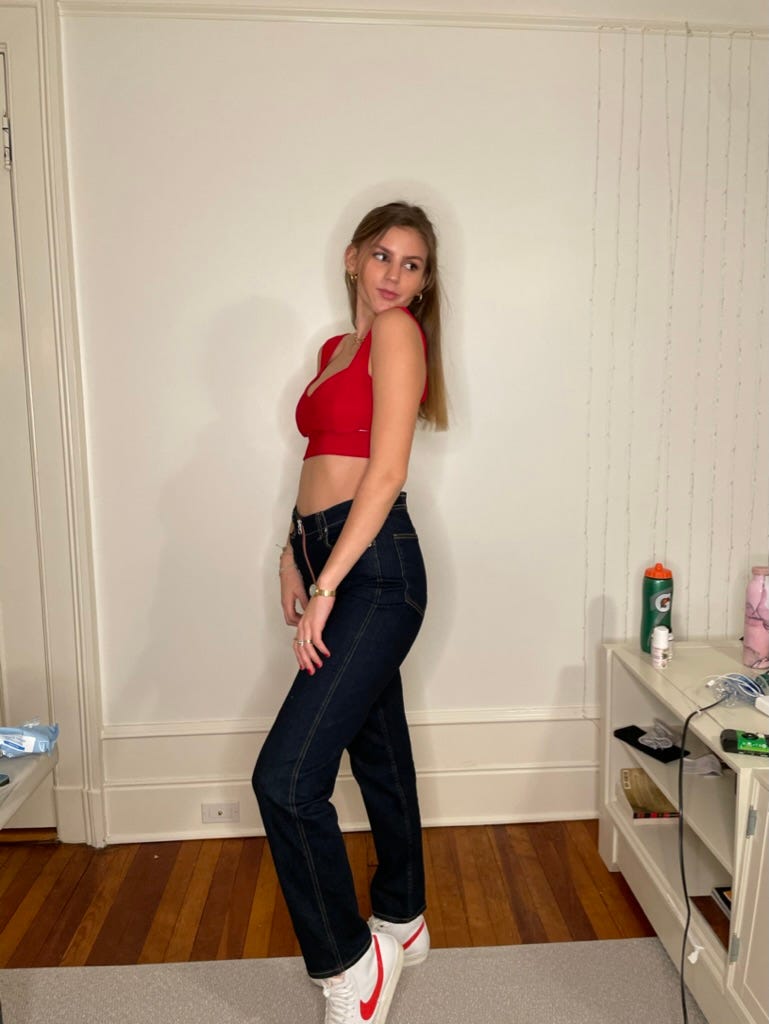
But then again, I believe that showing up imperfectly is better than not showing up at all. At least that’s what I tell myself…
If I have to exist on the internet and share my process and work so that I can try to make money in a way that doesn’t slowly scoop out the marrow of my soul, I think there is value in just showing up as you are: questions, mess, fuck-ups and all — oily and pimple-patched one day and full beat the next. In a perfect world, maybe I could only share short-form videos of my hands creating art or writing, but if I’ve learned one thing from my almost-year back on instagram, it’s that some people engage for the art, but the vast majority of people engage for the human. Because art/creativity is expressing our humanity, our questions, our glorious messiness, what I like to call our “human juice” — which is a central reason why AI could never make it. Art is as much about what’s on the page or in a song as it is about the person who created it. And even the slivers we see over social media or wherever we find it, are some sort of interpersonal connection, even if we don’t get to decide what kind of connection or how the story or art is received.
The Ghost of Pride’s Past
If you thought I was writing about Pride, stay with me, I’m getting there.
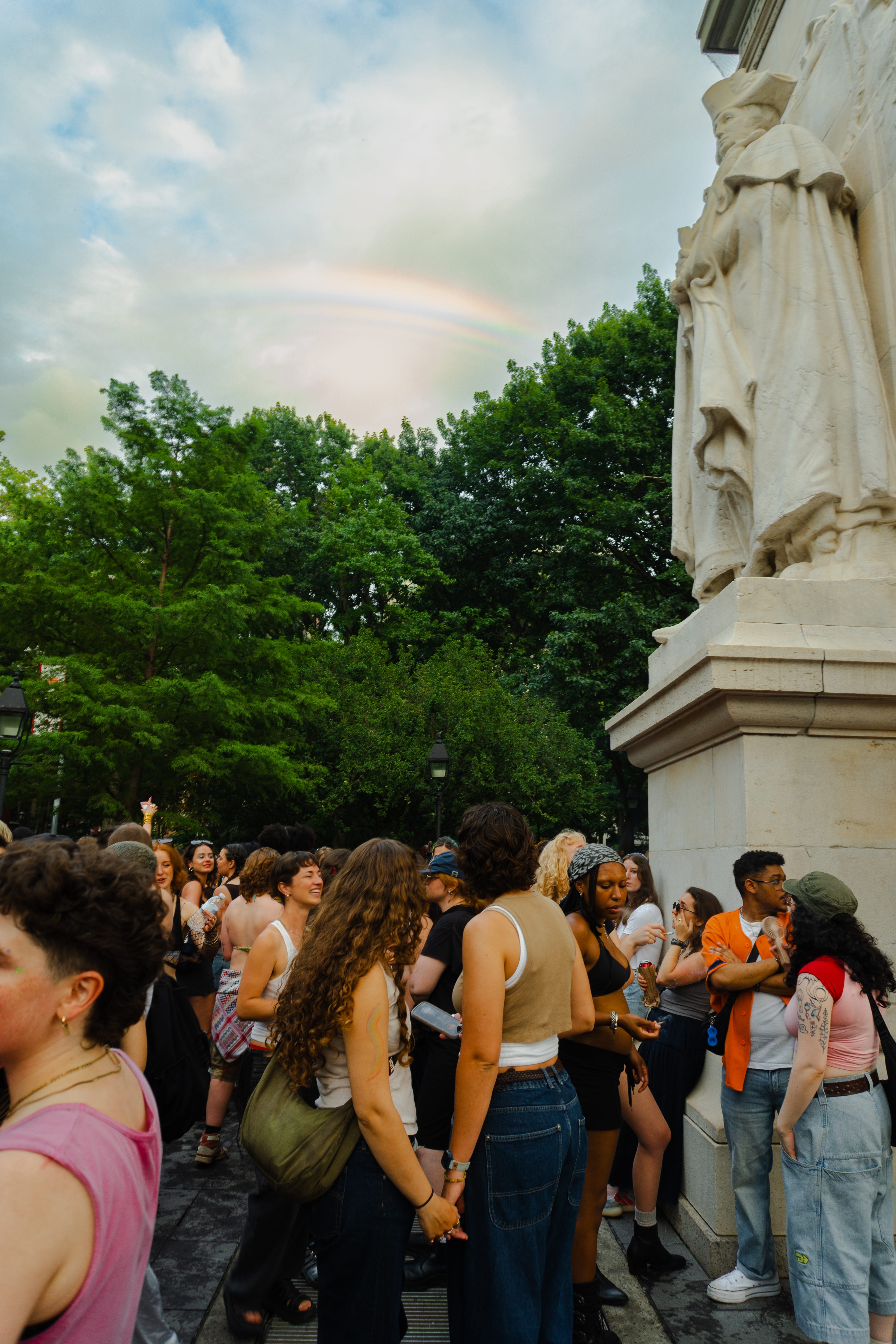
But first, I wonder if I asked you to think about Pride, specifically gay or queer pride that usually happens in the month of June, what image would pop in your head? Is it a party? Is it a crowd of queer people? Is it music blaring? Jock Straps and Rainbows and Dancing? Mine used to be.
Specifically, I imagined Washington Square Park on the last Saturday in June. The way I saw it at 18, the first Pride I had ever been to. I was a naive baby gay in sheer awe of the amount of queer people that simply existed on this planet. Prior to that moment, they had only existed on the fringes of the internet or that one boy in middle school who dyed his bangs pink (Shoutout Will if this ever finds you.) Anyway, my image of Washington Square Park is geographically connected to the origins of New York Pride — meaning the West Village and The Stonewall Inn — but that’s not the reason it came to mind if I’m honest.
It came to mind because of the droves of sweaty queer bodies dancing in fountain water that is bound to give them a UTI (sorry bout it). Their dancing bodies create an undulating block of rainbow, swaying and almost as dense as the green overstory and treebranches above. It is a joyous memory and one I sought out for years after, locating this elusive Pride within the mass of bodies and geographic space, only a hazy understanding of why Pride is held there in the first place.
One year after that fateful first visit, I was staying at my friend’s apartment to spend the weekend recreating this memory, both of us now in college and out as queer. While she took a nap, I went for a walk. I used to love walking around Manhattan. I found it to be one of the only places I could walk without someone giving me a second glance and I found that incredibly comforting. In the year since my first Pride I had done a 360 in terms of gender-presentation, long blonde hair traded for a bleached buzz, she/her traded for they/them. It felt fucking fantastic, but I didn’t see many other people that looked like me at college or in my hometown and I craved that kind of solidarity and visibility.
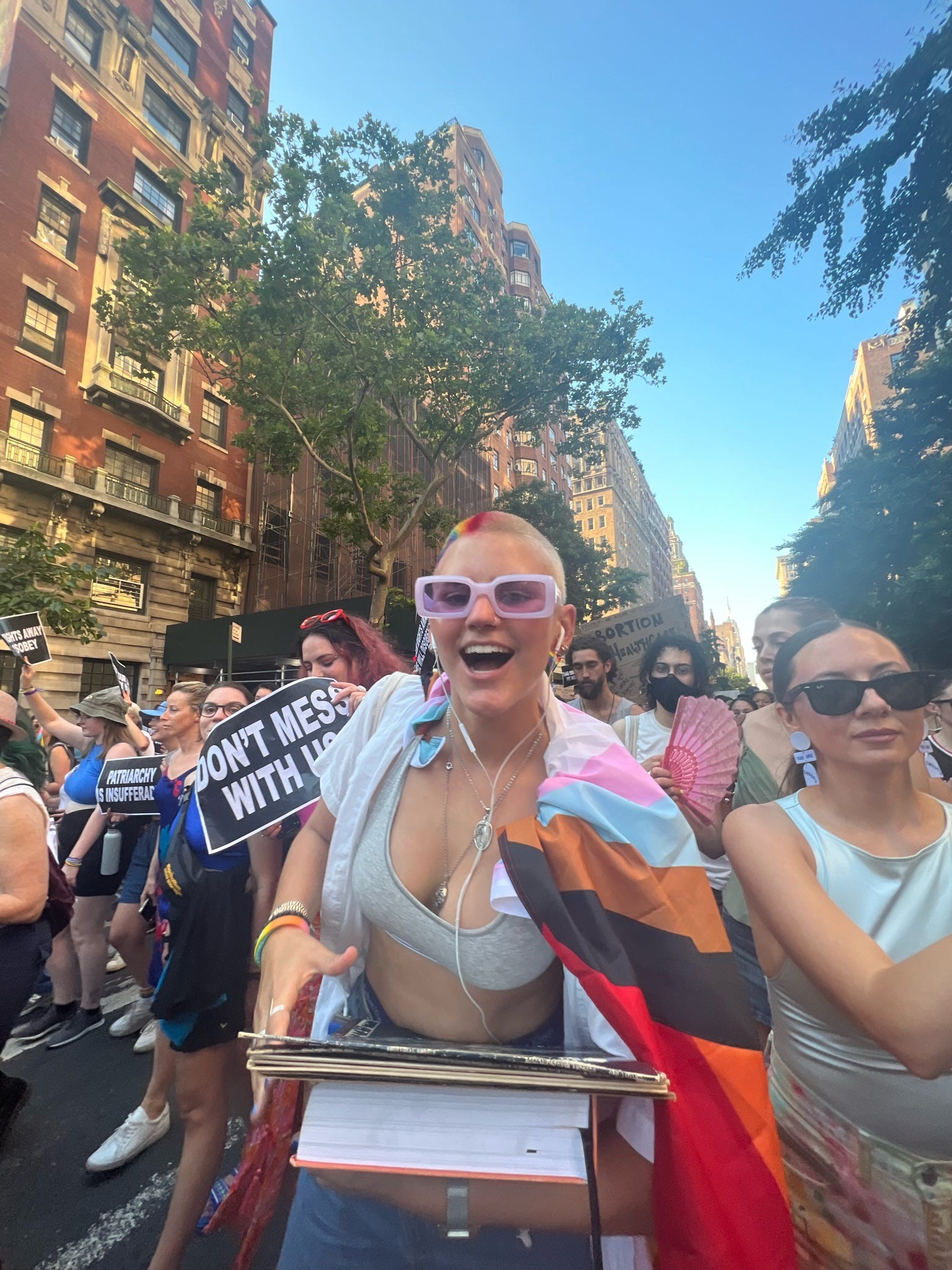
That wasn’t the case in New York. As I wandered back to my friend’s apartment, I encountered a sea of humans slowly streaming down 5th avenue. But not just any humans, humans that looked like me, queer humans, butch humans, masc-of-center humans. A quick google search combined with the context clues as I gathered as I walked toward them told me I was in the midst of the Dyke March, something I did not know existed prior to that moment. But some sort of queer magnetic force pulled me towards them and my feet held no reservations to joining their orbit, letting them surround me and chanting with them as if I’d been there the whole time. When the sea would ebb at a stop light, I would stand on my tippy toes to see how far this ocean of queerness extended up and down the avenue — it looked like forever. I never wanted to leave this new image of Pride, this sound of beating drums like a heartbeat that kept thumping even as I headed back to my friend’s apartment, not letting me forget.
“Pride” exits stage left. Cut to: Authors, Words, Books, Stories
For the past few years, I didn’t engage in this Pride of New York and queer bodies, the only Pride I knew, really. I simply couldn’t. My body was perpetually hurting, stretching and aching in ways that made my every step and day feel unreliable. But my existence is inherently queer as fuck, so it’s not like I wasn’t engaging in gay shit all the time — hell, my special interest is litereally drag. But these years were a pretty lonely time for me: I was developing a physical disability in the middle of college, a time when most of the kids around me were pushing their lithe limbs to the limits with all-nighters and alcohol-fueled binges; and I was stepping into my transness in all its simultaneous glory and ache, experiencing immense dysphoria and eventually seeking gender affirming care, unfortunately without a trans community to rely on for support.
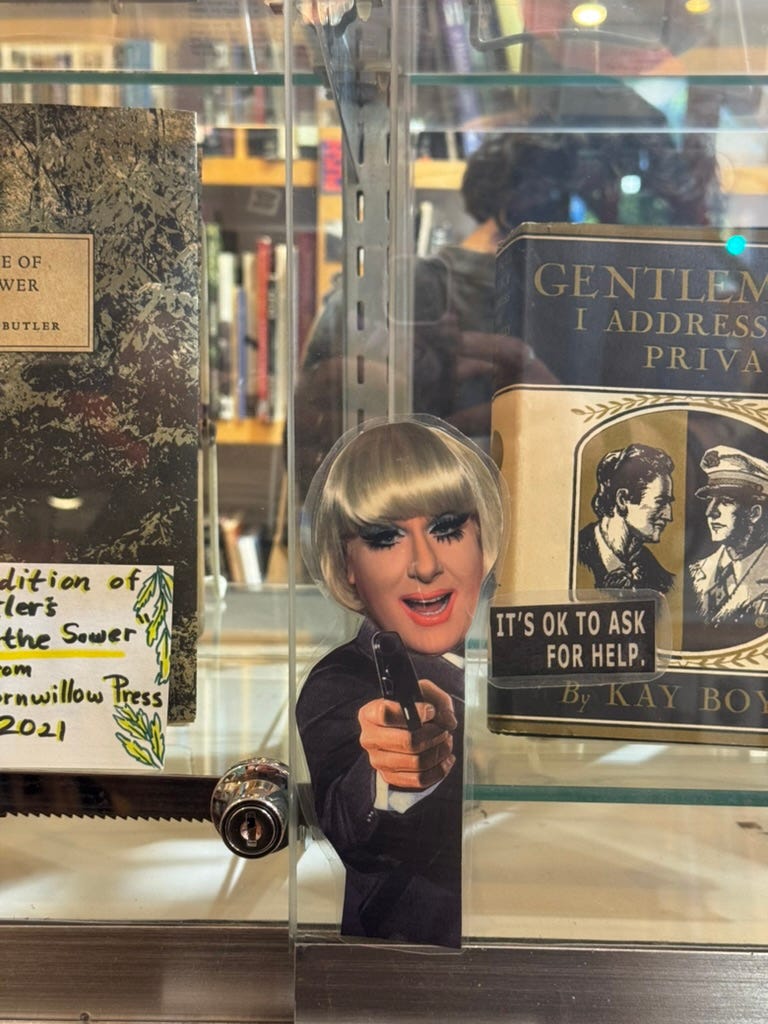
I wasn’t well enough to find folks I could relate to and learn from in my day to day life, but I ended up finding them in a form that was a bit more accessible: books and authors. Those years were dark and musty with depression, my mind felt cloudy like the ocean fog that would lick the windows of my moldy Southern California apartment. But I found visibility through the voices and words of queer, trans, and disabled authors; through them I accessed community, company, compassion, and care that quite literally saved my life. There were many books specifically by queer and trans authors, not only about their lived experiences, but about queer history and culture, allowing me to place myself in a lineage of queer and trans activists, authors, and thinkers. There were other books written by disabled writers that helped me understand how I’m not alone in being a young disabled person, the history and theory of disabled activism and thought, and how our entire existences are shaped by ableism even though disability is the one thing we are all bound to experience.
This kind of questioning and answer-seeking through written and spoken word has become an integral part of my existence on this planet. One of my favorite ways to spend my time is reading or listening to an audiobook, especially ones that are designed to make a complicated subject accessible, render a certain experience as visible, or destigmatize different ways of being. I often joke that I’ve learned way more after I’d graduated college than when I was in it. But it’s true; my way of being, my creativity, what gets me out of bed in the morning are all related to the authors, books, and the words I’ve read and will read, as well as the questions and ideas they elicit within me. Whereas social media can compress an idea or experience into a format digestible for the algorithm monster, a book allows an experience, history, or idea to expand and exist in boundless contexts.
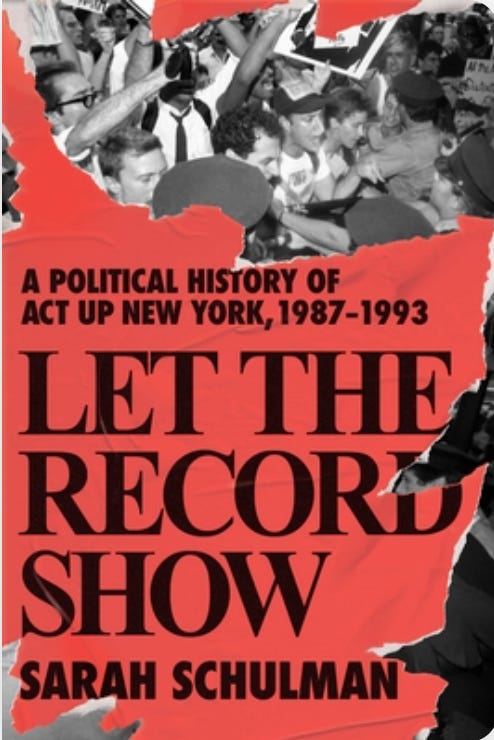
As part of this questioning, I learned a whole lot about this idea of Pride and how it came about. The gateway drug was Leslie Feinberg’s Stone Butch Blues and from there I got hooked on The Stonewall Reader and it spiraled into Tourmaline’s Marsha and Sarah Shulman’s Let The Record Show.
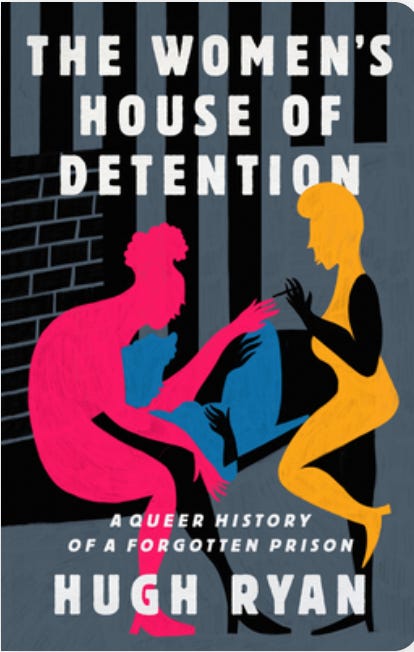
Turns out that Pride, specifically New York Pride, is not all about blaring music and bouncing bodies. I now know there is a gated garden on 10 Greenwich Avenue that was once the Women’s House of Detention, the beating heart of queer life and culture in the West Village before it was demolished in 1973. I now know that Washington Square Park used to be known as The Potter’s Field, where a public gallows hung and those who could not afford to be buried privately were laid to rest and still remain today — often those who lived on the fringes of “normal” society like gender-nonconforming folks or sex workers. I now know more about the riot at the Stonewall Inn on June 28, 1969, an action born of the swelling momentum built by the 1966 Compton’s Cafeteria Riot in San Francisco and the Sip-In at Julius’ in New York’s West Village protesting bars using the State Liquor Authority’s regulation to prohibit service to homosexuals.
I now know about various queer activists and social organizations that cropped up from the Daughters of Bilitis to the Mattachine society to STAR (Street Transvestite Action Revolutionaries) to GMHC (Gay Men’s Health Crisis) to ACT UP (Aids Coalition To Unleash Power), all with unique histories of organizing for queer rights in the 60s and 70s and healthcare amidst the AIDS epidemic in the 80s and 90s.
I now know about how queer history has been white-washed, made more palatable by focusing on white gay men as the knights in shining armor of Stonewall, when in reality there were people of color, dykes, butches and femmes, drag queens, and transexuals there as well. I now know how the history of a singular night can be complicated, bound by the unique recollections of human memory. I know there is so much that I don’t know. I know that I can’t wait to spend the rest of my life continuously learning.
I now know Pride may look like joy and dancing today, but that was only made possibly by the trans and queer folks that came before us, who endured police brutality, homophobia, structural violence and discrimination, straight-up violence and discrimination so that an ocean of Dykes can now flow down 5th avenue and dance in the flowing waters above The Potter’s Field.
Instead of grossly paraphrasing more stories of queer activism and Pride, I’m going to point you in the direction of the books that I continue returning to with questions. If you want, you can skip to In The Stack for those, or you can stick around to hear about how I ended back at Washington Square Park, 5 years after my first Pride, my experience of it as a person in a non-normative bodymind complicating this image I have held onto for years.
Disabled Trans Dyke
I thought about attending New York Pride last year, specifically the Dyke March I’d remained enamored by since first coming across it years prior. I was about 2 months post-op from top surgery and I tortured myself wondering if I could make it through the march, not just physically, but mentally. The marshalls have made a huge effort to make the event more accessible in the past couple years, with a form available to request a wheelchair and a marshall to push/escort you if needed. This was a huge push in thinking maybe I could… but what felt most terrifying and inaccessible was the crowds, not just within the march itself, but getting there and back on subways and trains.
Becoming physically disabled and seeking gender affirming care within the span of two years meant a drastic shift in my way of being in a relatively short amount of time. Life felt (and still feels) terrifying and uncertain, and keeping myself from crashes leading up to surgery and recovery was always front of mind, not to mention in general, given illnesses have drastically shifted my capacity for months before. Being covid-cautious and trying to care for myself and my community is a logical measure, albeit confusingly hard to understand for some people who have the privilege of pretending the pandemic has come and gone. For me though, taking covid and other viral precautions morphed from this logical, caring, harm-reducing measure into an intrusive thought-loop and rumination about exacerbating my disabilities.
I am autistic and have OCD, which means my mind can latch onto interests, thoughts, or ideas with a committed ferocity. Awesome when it comes to a new project or hyperfixation; not-so awesome when it’s an intrusive thought loop. So unfortunately this logical measure of care morphed into a bone-deep contamination fear specifically surrounding viruses and covid in particular. There were many months where I only left the house for doctors appointments or PT, the amount of social interactions besides the ones I had with my family at home were limited to the pharmacist and one or two friends, after which I could spend anywhere from hours to days ruminating on whether the interaction would result in sickness. I could probably count on one hand the amount of times I left the house. Not because I couldn’t or I didn’t want to; I deeply wanted to see friends, see people, yearned to simply observe human conversations, but the constant circulation of fear and even the fear of the fear/rumination itself would keep me frozen and exhausted from the energy of the thoughts zipping through my brain.
The unfortunate kicker is that this isolation wasn’t protecting me in any way either. For the past year or so, I’ve been living at home with my family, who take zero precautions when it comes to their social lives, so my efforts to shield myself from risk of illness was only further isolating myself and sending me deeper into depression. How I’ve learned to dance with this specific rumination is another story, but suffice it to say that this vision Pride — the Dyke march and sea of queer bodies — became somewhat of a specter to me, looming as I ached to be among this crowd of queers while forced to remain semi-closeted at home. Pride, as it exists on the last weekend of June in New York City, is something I yearned for yet remained terrified of.
When I envisioned Pride and the Dyke March, the risks that my mind played out were both justified and inflated. But this is like any other risk or decision, and for the past few months I’ve slowly started to weigh these risks based on if something is aligned with my values in an effort to exist in society alongside my fears so that I can engage in the situations I so deeply crave as a human. That looked like slowly visiting cities as moving out research, reconnecting with friends, vending at art markets, and buying concert tickets for my favorite artists. There is an extent to which my self-isolation keeps me and others safe, but there is also a point where this isolation is bringing about further isolation and depression. I’m still learning how to endure risks to my own health while reducing harm and trying to keep others safe when I can. This way of being is a work in progress and related to my continued learning and questioning about how to make spaces accessible and live my life based on principles of disability justice.
Long story short, this kind of thinking and decision-making and mini exposure therapy helped my OCD and intrusive thoughts get quieter — a low hum occupying my mind on most days rather than clanging of pots and pans that I’ve endured for much of my adult life. And all of June I made the kind of decisions that would prepare me, both mentally and physically, for going to New York Pride, specifically the Dyke March. I wanted to experience being held and surrounded by trans and queer folks, be in that geographic place known as Manhattan in that last weekend of June, somehow connect to the legacy of the trans and queer folks who fought for me to exist today.
They Have Risen (made it to the Dyke March)
Leading up to my train time on Saturday, I had the kind of deep physical anxiety that glues you to the toilet seat for most of the day — at least that’s my experience of it. I’ve read that when your body believes a threat is coming, that good ol’ fight or flight response wants to empty your bowels of anything that could weigh down your escape from said threat.
But there I was, running towards the threat instead. Well not exactly running, I can’t do that, but hurtling towards Manhattan on the Metronorth, listening to MUNA’s new album and hoping it would inject some sort of gay calming strength into my veins. MUNA can do a lot of magic, but unfortunately my heart still beat into my throat as suburban expanse gives way to higher and higher buildings until New York was gradually forming around me.
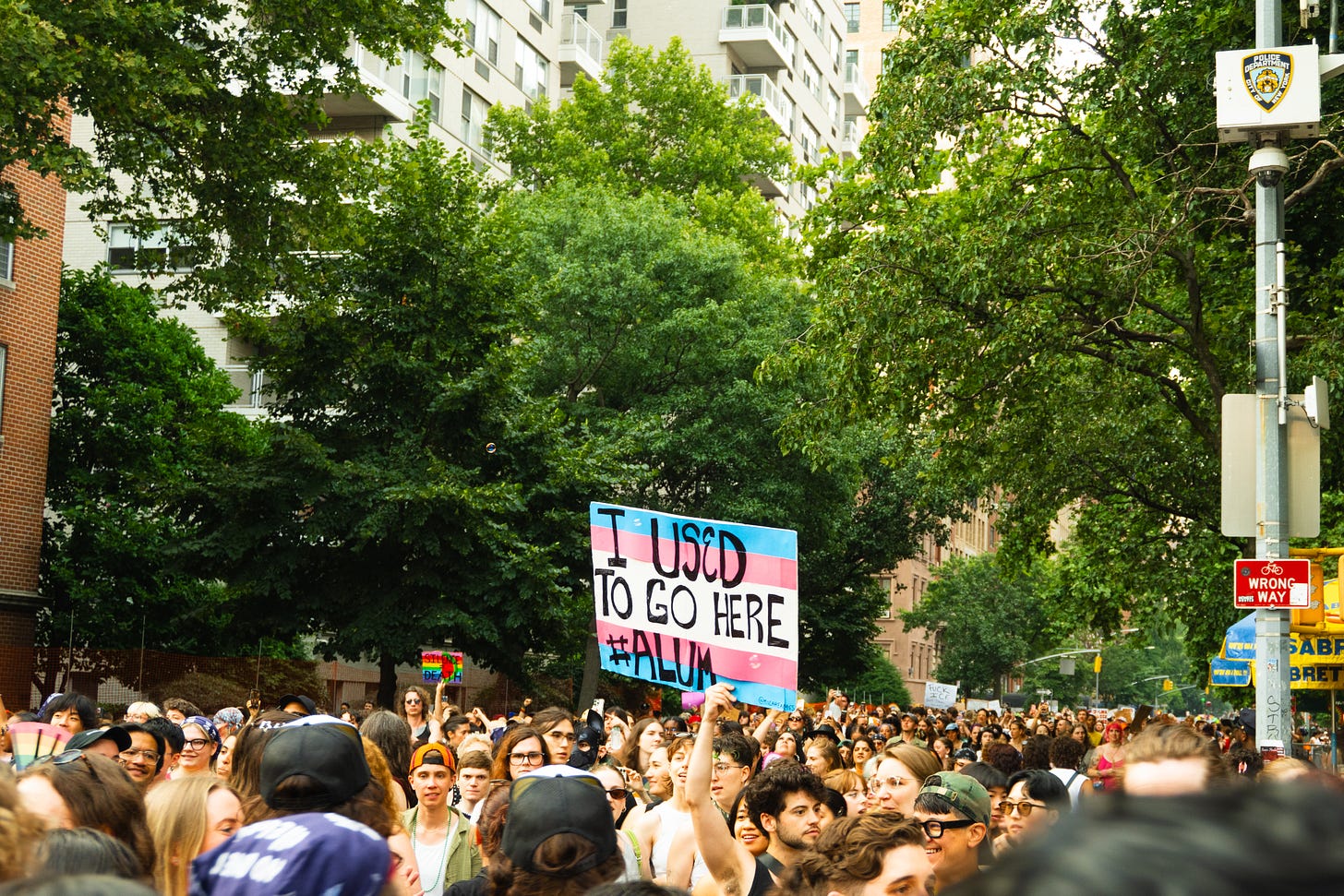
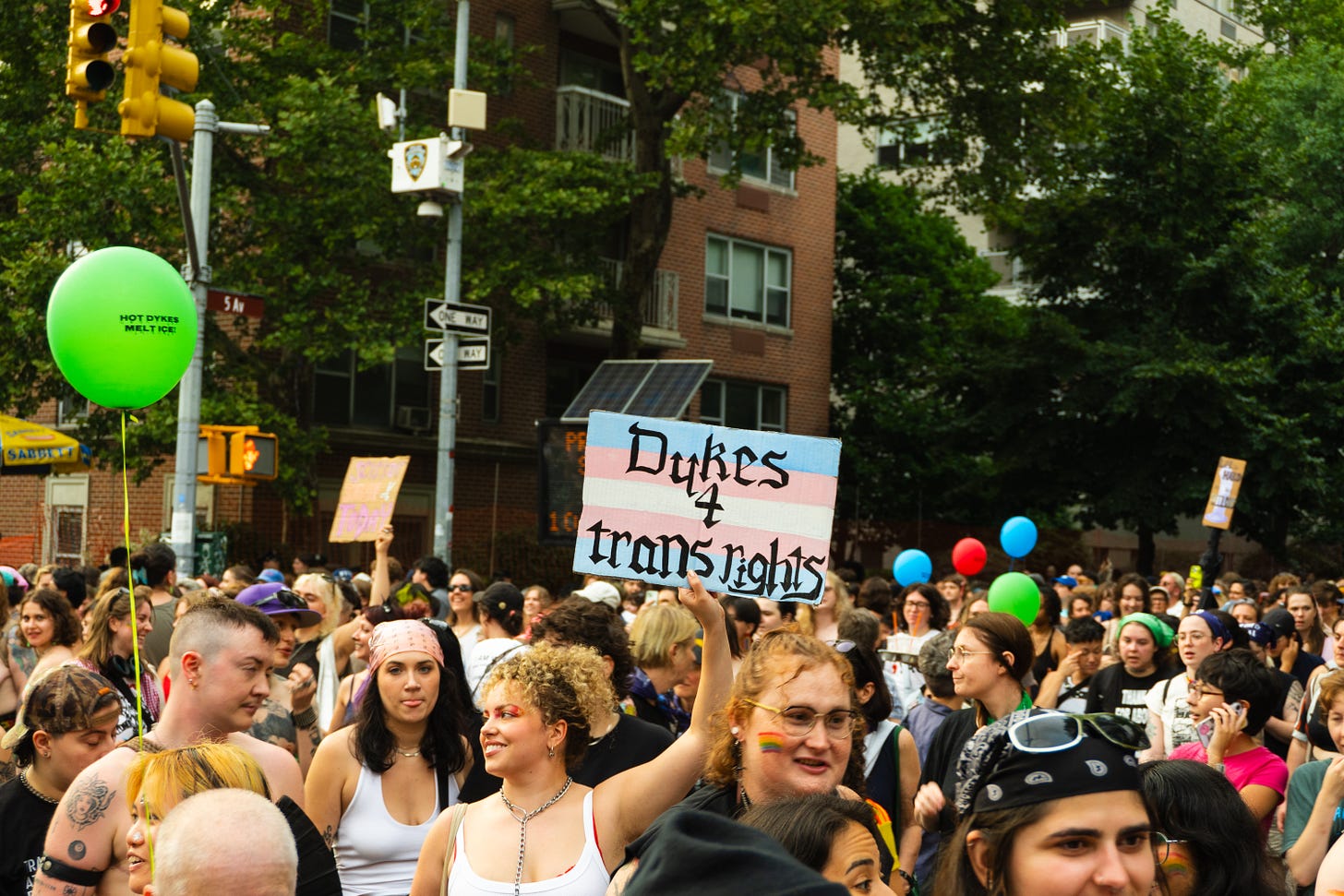
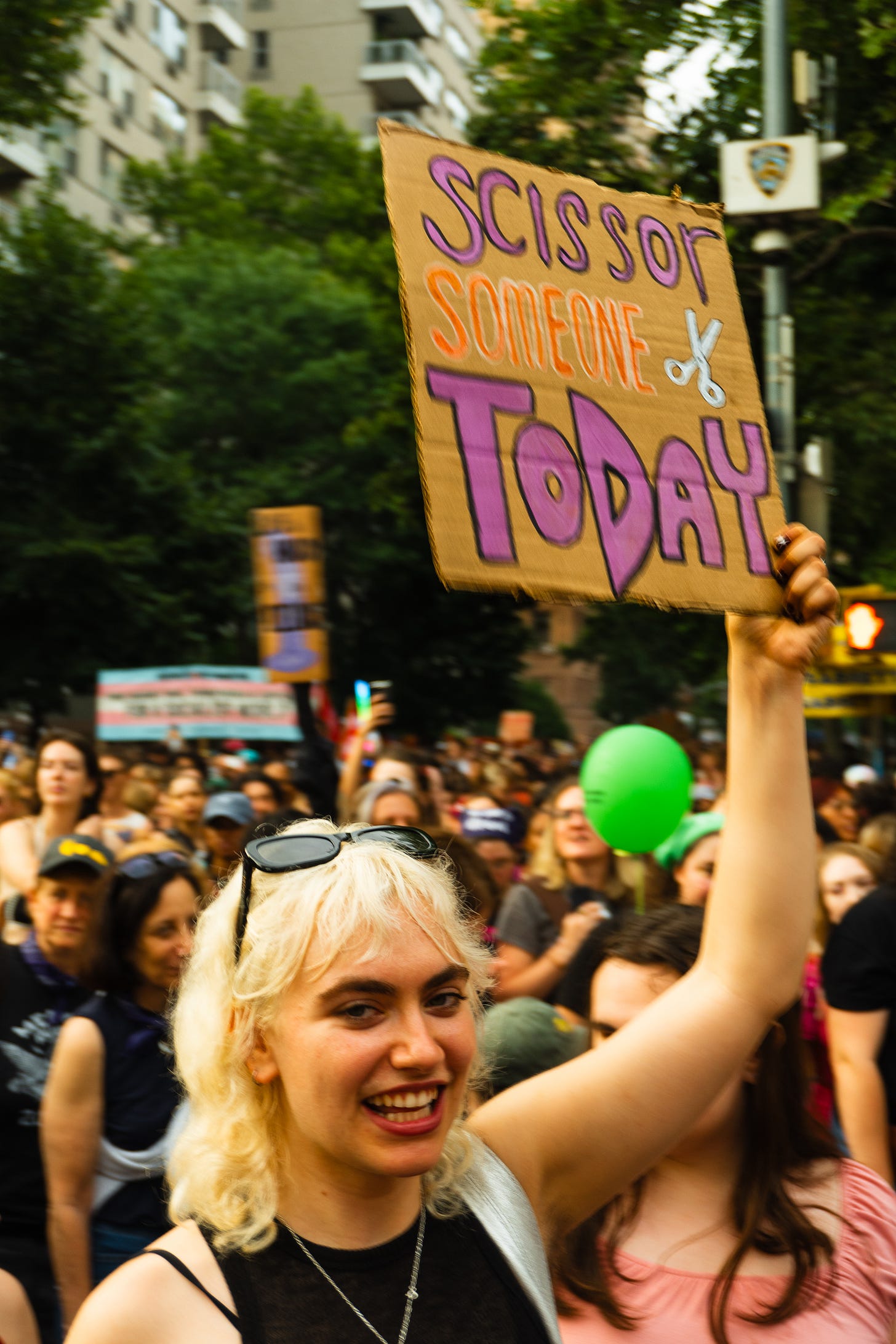
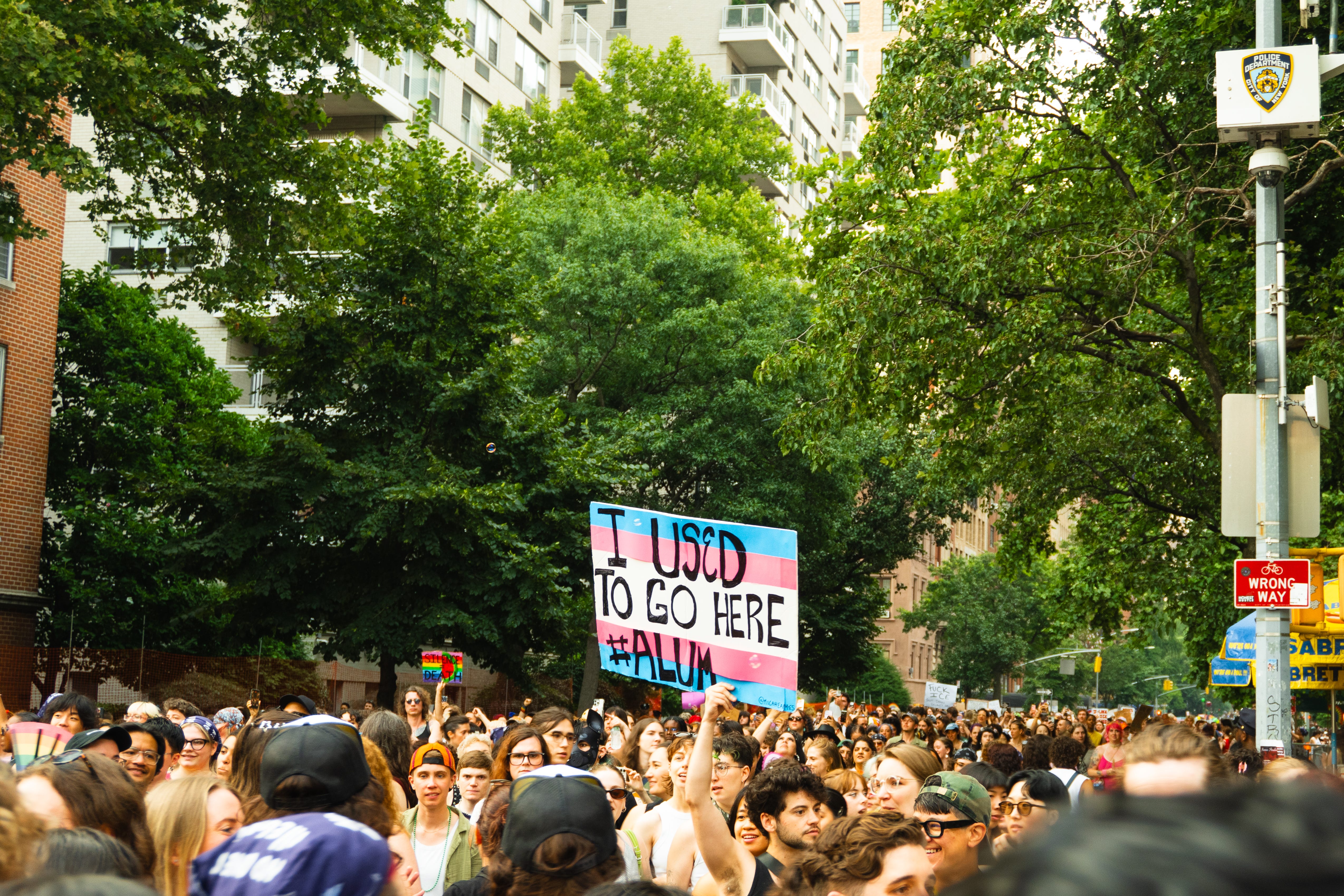
A couple hours later, there I was on 5th avenue with two friends, out of breath, right hand gripping my forearm crutch and wondering if we’re late — trick question because gay time. It’s drizzling and the crowd is buzzing, a collective vibration of sapphic joy and anger and liberation powered by blundstones, sambas, wheels, pleasers, and a factory-worth of doc-martens. I try to read all the signs around me, although it’s an impossible task to swivel my head around while also trying to see where my feet are going on the pothole-riddled avenue below. Here are some that I remember:
No LGB without the T
It’s our pleasure to serve cunt
hot dykes melt ice
i used to go here #alum
I like my ice crushed
No One is Illegal
Dykes 4 Trans Tights
SCISSOR SOMEONE TODAY
Gender? I hardly know her/them
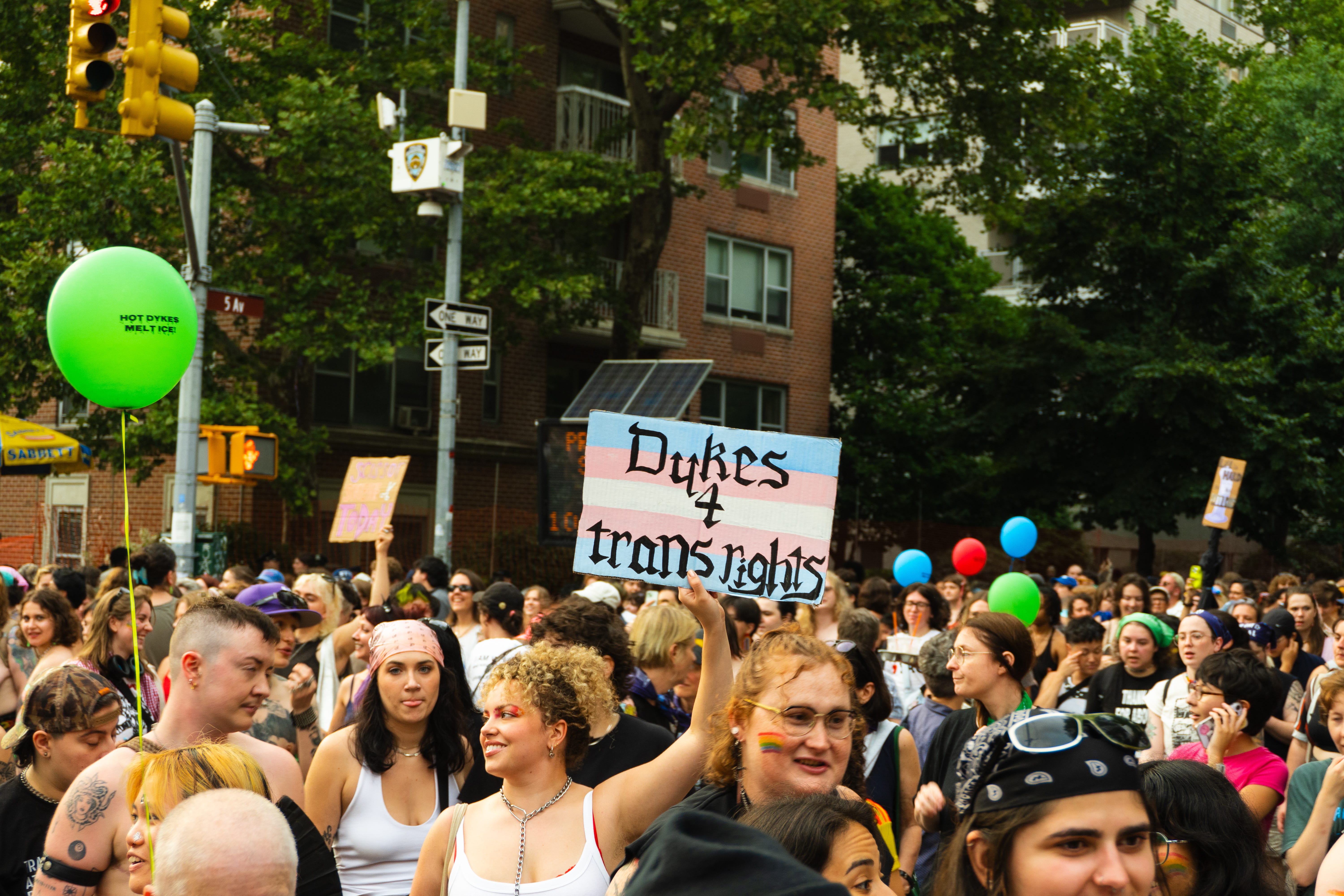
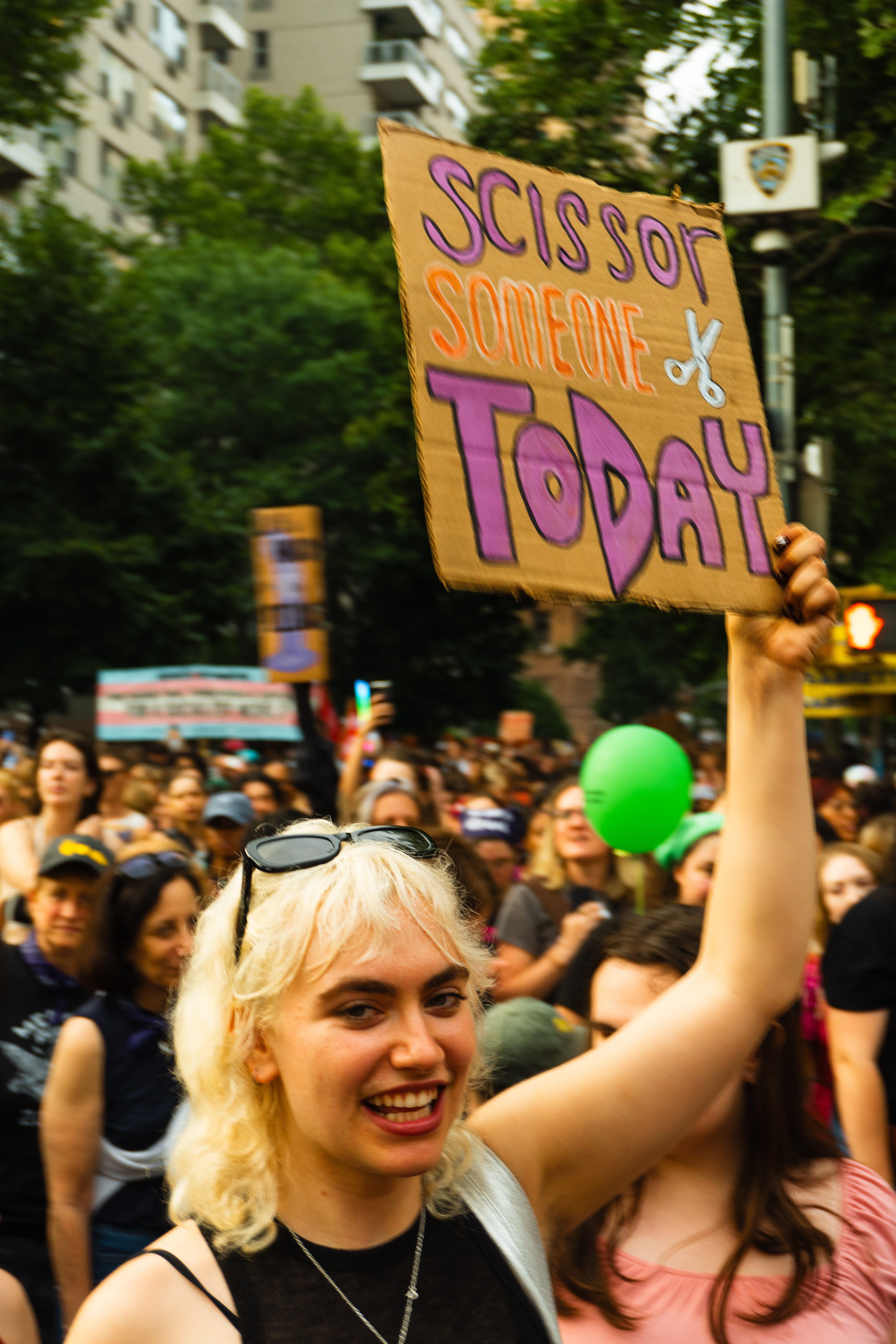
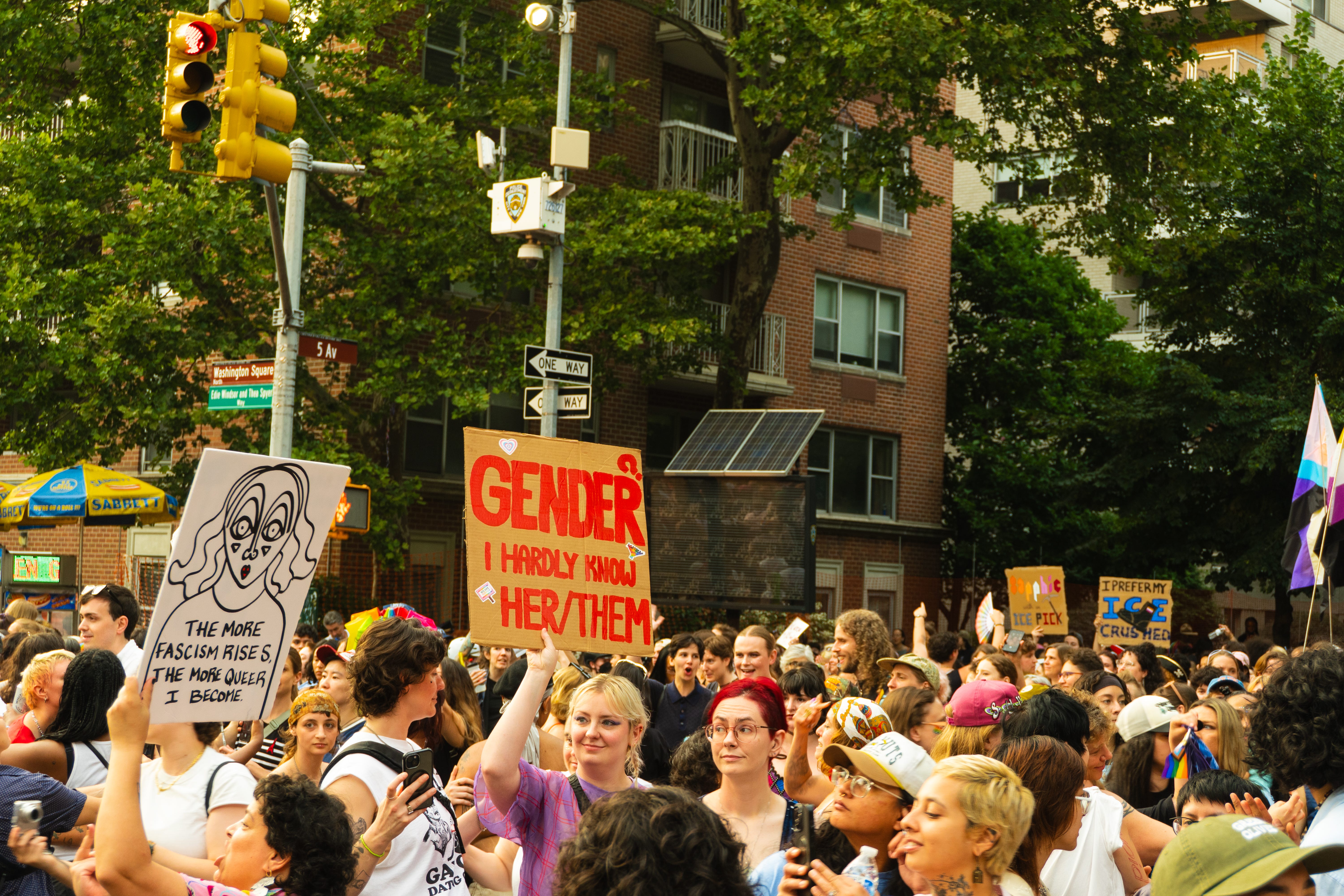
My friends and I collectively decide that the walking pace was going to be difficult for us to sustain, so we grab some Korean food and meet up with the march at Washington Square Park via Subway — a plan I am very grateful for because I don’t think I could have survived those almost 30 blocks on top of the walking I already had to do that day (probably should have requested a wheelchair).
As we walk towards the park, we realize we’ll be waiting for the march’s arrival, the din of chants and drums in the distance. We park ourselves at a traffic-light in front of the arch to watch this beautiful ocean of queerness start streaming in the entrances on either side of our parking space. This is my favorite part of the day. As much life as I’ve lived since experiencing my first p ride 5 years ago, I remain awestruck at the sheer amount of queer people that congregate for such events. There is this deep disconnect between the loneliness I’ve often felt as a queer and trans person and seeing queer and trans people like myself take up block after block of space. In an effort to remember this feeling, I try to take in every face that my eyes fall on. I wish I could create a yearbook of queerness to flip through later, when I feel especially alone (maybe an idea for a future dyke march). No face is the same, and I try to commit the details to memory: the freckles, the color of masks and glasses, the glitter, the angular jaws, the soft faces, the shaved sideburns, the colorful streaks of hair. I want to remember it all. It feels like every time I commit a face to memory, I see another and the one before becomes a bit fuzzier.
I especially love seeing the older lesbians, a comfortable swagger in the way they wear their clothes, hair graying in the way a heteronormative society teaches us to hide, deep and beautiful wrinkles around eyes that have seen and known much more than my own. They bask in their glory of existence, occasionally looking at us younger queers, oscillating between expressions of love, awe, and shock like we might have a glob of pasta sauce in our hair.
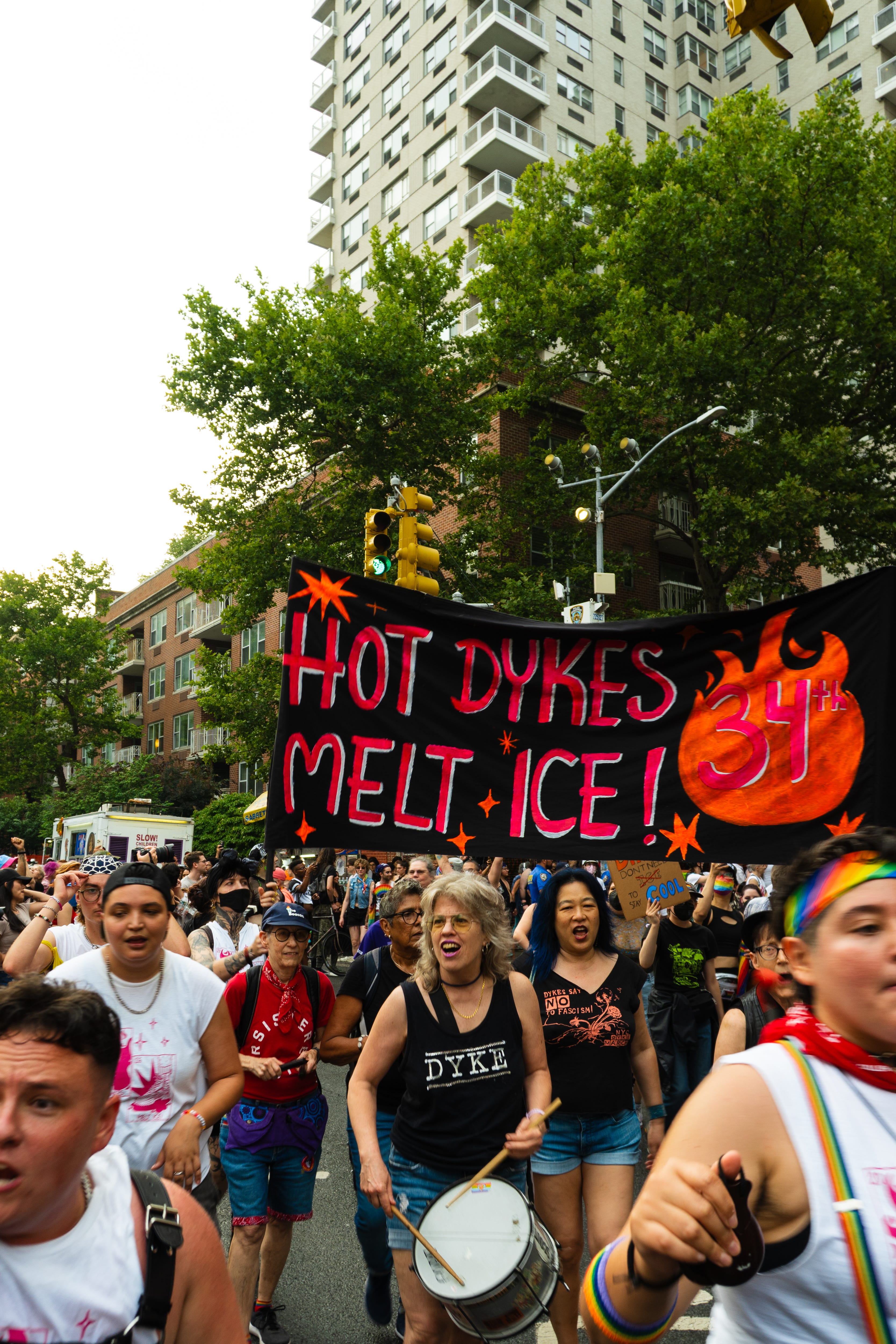
Soon enough, the drums grow louder before we see the banner that reads, “Hot Dykes Melt Ice! 34th Annual NYC Dyke March.” Historically, the drummers have led the march — us queers are too busy chatting or getting distracted to know when it’s time to move or stop at a traffic light — the drums act as both cue and guide, that heartbeat I heard throbbing years before. Each drummer is singular in their movements: how they choose to time their legs with their arms, how high or low on their chest or stomach their drum sits, whether or not their eyes are open or closed as they connect with the beat. Together though, their movements and sounds meld together into a singular ocean wave, pushing the wide banner towards the arch of Washington Square Park.
With the drummers is a mask-mandatory block in the front. A concentrated group of disabled dykes, their presentations as diverse as the types of mobility aids I see before me: chairs, rollators, canes, hiking sticks, crutches, and more. One person walks past me as I frantically snap pictures with my camera and asks where I got my cane (coolcrutches.com). In that moment of connection, I want to freeze time and ask for their number, give us crips just a few moments of quiet to recover from the overwhelm many of us are feeling, a moment to simply recognize the presence of each other in all our queer-crip glory. Alas, I cannot stop time, but I was happy to see us.
My friends and I eventually enter the park, which means we’re no longer on the lapping shores of this queer sea, but part of its currents and undulations. Because of the nature of my intrusive thoughts, it quickly becomes clear that no amount of exposure therapy could have prepared me for being in Washington Square park in the aftermath of the Dyke March. As beautiful as I just described, it was equally terrifying for me. I was grounded by the camera strap around my neck, bringing the viewfinder up to my eye and reducing the many stimuli around me to solely what exists within the lens. Clicking the shutter was a moment of presence — kind of — but also not really because I was worried about getting pushed or stepped on as I often do in crowds. Being as injury prone as I am, that’s a whole separate intrusive thought loop I’ve had to work through.
Being in the crowd makes my chest feel tight, an interesting realization given any amount of anxiety usually causes me to exit my body, much preferring dissociation and observation from outside my flesh. But in my chest, I felt this tenderness and tightness, the kind of tension that happens right before you get your period when you have boobs. Except I don’t have boobs anymore, so it’s just this deep tightness behind my incisions and within the cavities of my chest. I try to breathe through the tension and focus on the tenderness around me instead. Queer folks often joke about the “u-haul” lesbians or their jealousy of other’s affection amplifying their loneliness. I get it. But without coming off as creepy, I think that seeing dykes and trans folks kissing each other and displaying tenderness in an environment like the Dyke March of the most sacred things to behold. In that space and moment, their love or lust or care is the same amount of free in a public place as it would be in the privacy of a bedroom. I am comforted by these small moments of care: the tangled tongues finding each other under the fountain’s stream, the groups of friends lounging on the grass, the L-word-shane-haircut mascs making out under the march banner, or the person pushing their lover in their wheelchair and leaning over to land a kiss on their rosy cheek.
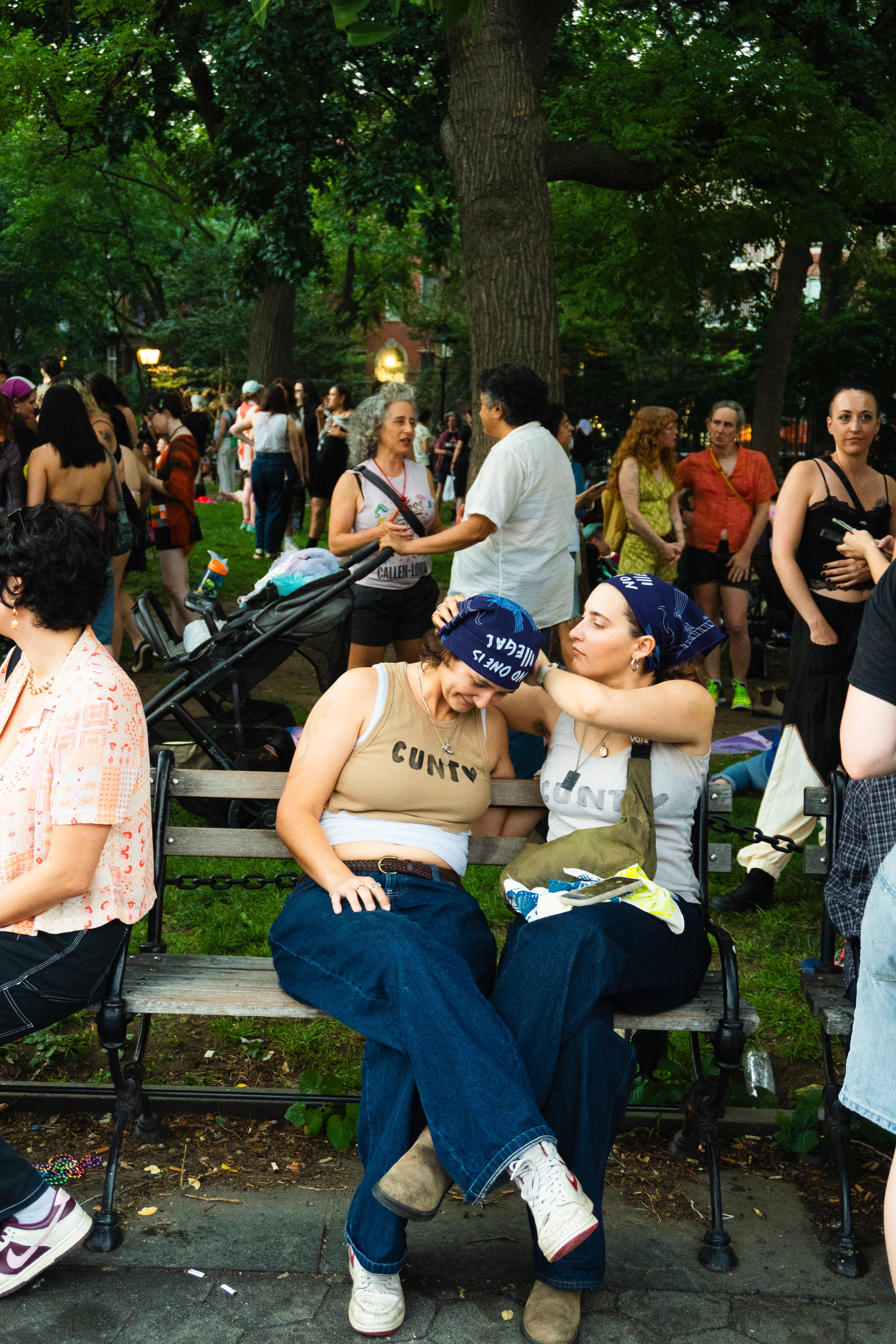
It’s here I notice not just how many self-identified dykes are here, but how many trans dykes there are, existing in all our glory. Stealthy or not-so stealthy, I see us doing pull-ups on Manhattan scaffolding, cheered on by a crowd of fellow queers; I see us with tits out and a leather harness over glowing bare skin; I see the the curves and straight lines of top surgery scars, often with phrases like “Dyke” or “Hot Dykes Melt Ice” scrawled across chests in eyeliner or lipstick.
I am utterly enamoured by this jubilant crowd of dykes. As unsafe as I personally feel battling my ruminations, they make me feel safe and a part of something. However, on top of the tightness in my chest, there is also an eerie feeling of loneliness while also being surrounded by kindred queer humans. Somehow, knowing how many of us there are, knowing I’m not alone, never alone, and knowing our capacity for immense joy and freedom makes it sting a little extra when I think about the fact that I haven’t found my people yet. I’m in this community, but I’m not in community yet, and there is a strange grief that mingles with quiet joy in seeing so many people who seem like they are in community and have found their people.
The air around me is filled with cigarettes and weed and New York and perfume and cologne and likely particles and viruses that I can’t help myself from picturing as I try to breathe. I put on my mask, take it off when I overheat and feel like I can’t breathe, only to put it on again 10 minutes later. My chest is still tight and my head is spinning and I want to make conversation with the gorgeous queers around me but my brain is fuzzy with fearful thoughts and the familiar buzz of an impending shutdown. I need to find a seat. I need to rest the feet that burn and hips that pull and back that feels sewn together by string.
Around me, people struggle to exit the bedlam of the fountain. They look like drowned mermaids, reaching for a hand that will pull them out of the water and make them human again. Once free, they contort their beautiful bodies to put wet feet into socks and consequently wet socks into shoes, squelching as they walk towards the grass to join their friends. Those with hair twist it out like a wet t-shirt, the fountain water creating abstract puddles on the hot concrete.
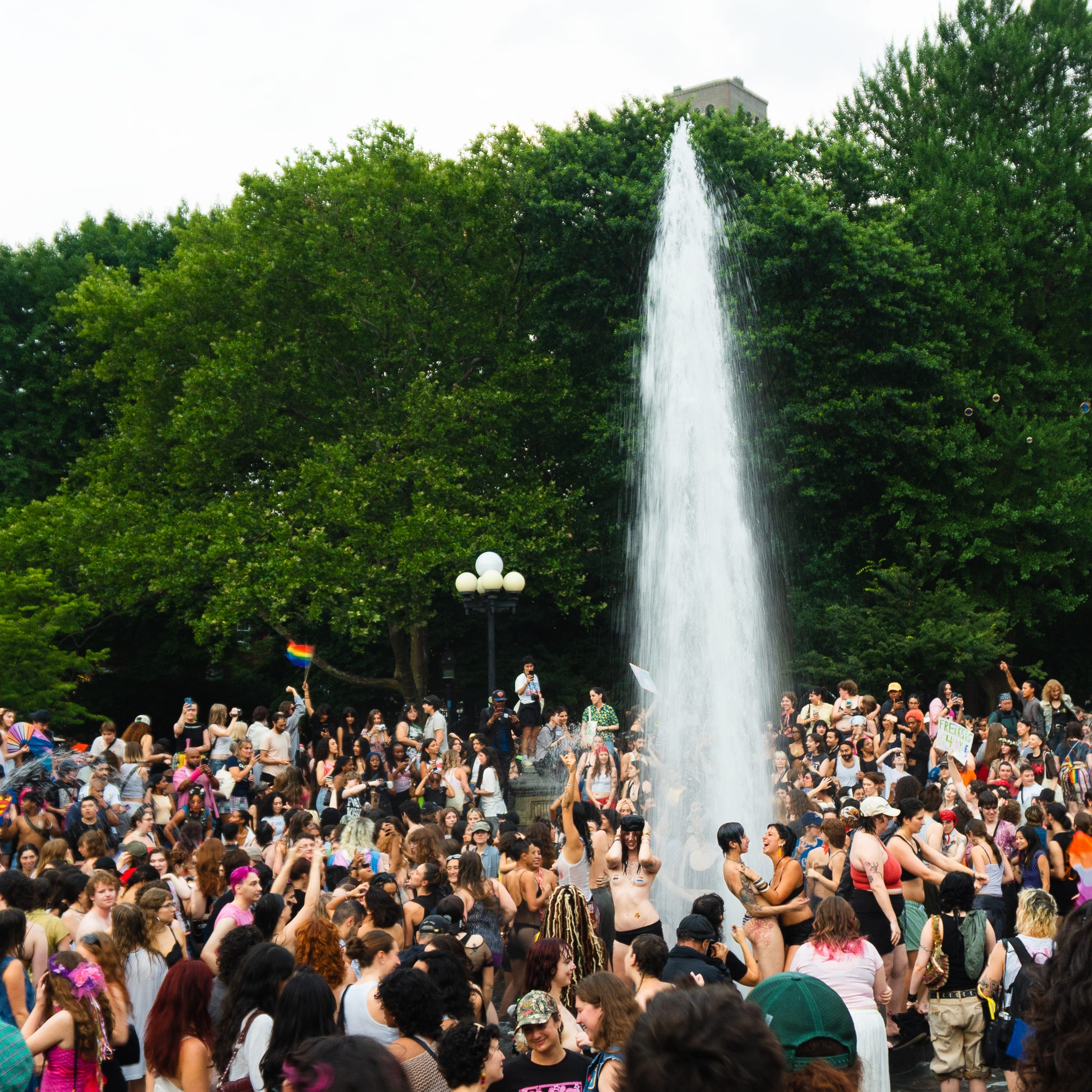
It’s a beautiful scene, and at the same time, I wish it was quieter? It’s immensely awesome that there is this boisterous crowd of sapphics taking over a park, but it was hard to navigate as a disabled person. That’s no fault of the organizers who truly tried to make the march as accessible as possible. They werew all wearing matching shirts, masks, providing wheelchairs, escorts, and reimbursements for cab rides so that dykes can save spoons. There is so much history tied to the Dyke March and it’s a privilege for that lineage to grow through the organizers and participants, a joy to feel connected to all the dykes that came before us, and I want it to feel easy and simple. I want to feel only gratitude and joy, or rather, I feel like that’s what I should feel.
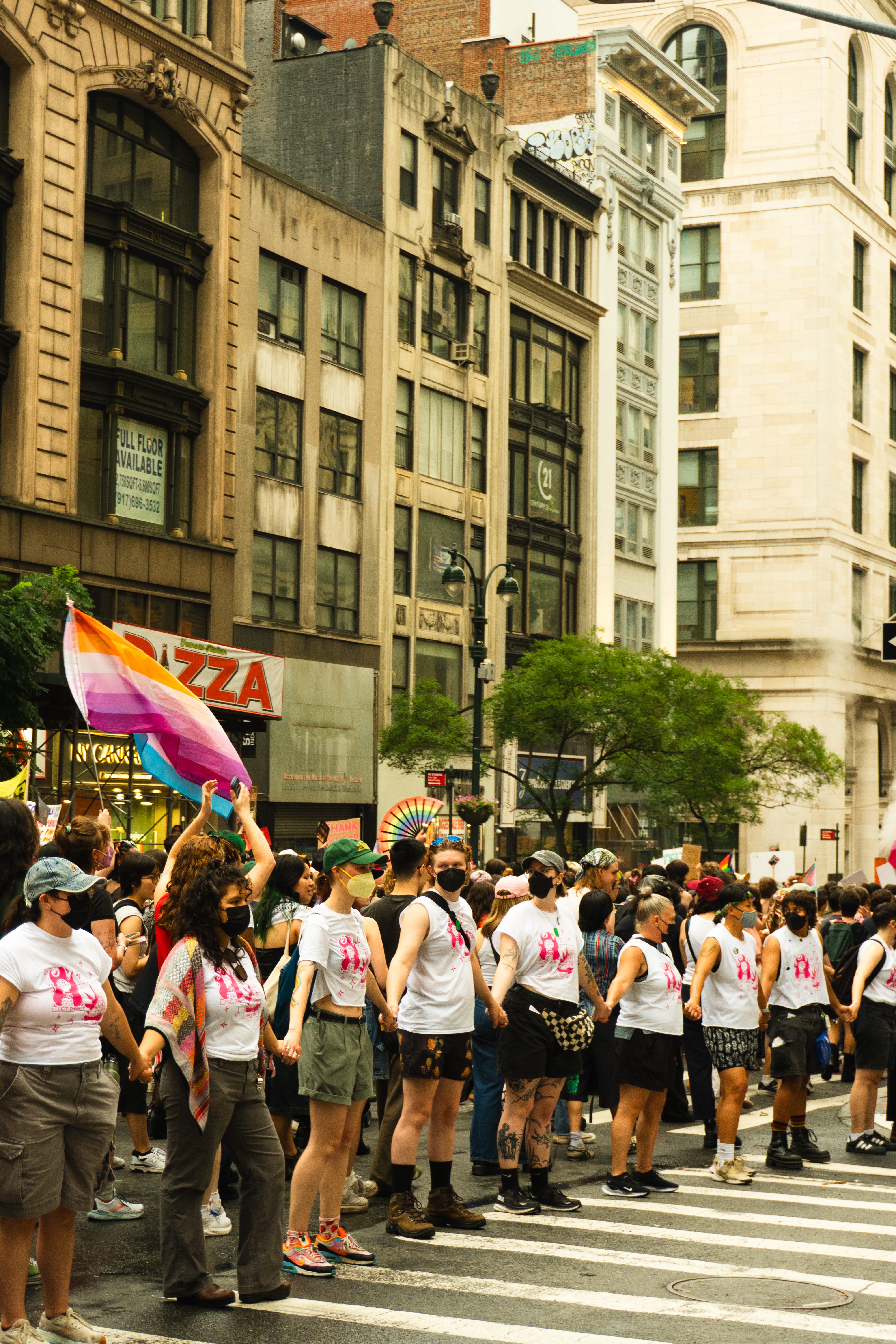
But in reality I feel like my feet are about to fall off my body. I feel like I took an hour train, 3 subways, and walked four miles to get there and back to the apartment I’m staying at, and there were multiple moments where I thought I wouldn’t be able to make it. I feel like it cost more than 40 dollars to feed myself and get myself there. I feel confused about how anyone can afford to live in this city, not just monetary, but physically, emotionally, and mentally. I feel grief for a time when I could be in that crowd and feel unbridled joy without anxiety or rumination. But I also wonder if that time ever even existed in the first place.
I write most of this on the Metronorth home. It’s Sunday June 28, proper New York Pride Day, and I watch New York disappear into Fordham and Mount Vernon, thinking about all the queers traveling in the other direction. I tortured myself this morning, trying to “trust my gut” in deciding whether or not I could make it downtown to participate in PrideFest and the parade. I technically could make it there and I do want to — I want it to feel easier than the day before, I want to feel more joy and less anxiety, more happiness, more lightness. But despite my desires, my body aches and trusting my gut feels like solving an escape room. I want to feel these things about Pride, but I also feel like I should.
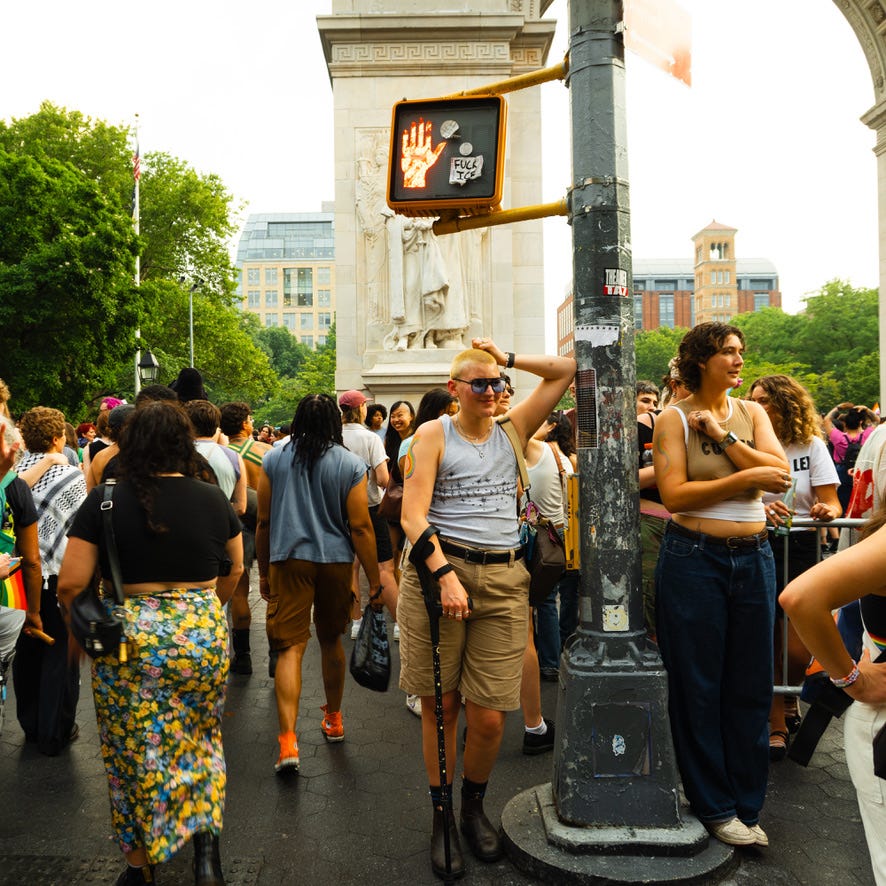
But what is Pride if it depletes you?
Pride, Now
It’s taken a while, but when I think of Pride, I don’t just think of pulsating bodies in Washington Square Park’s dirty fountain. I still think of the West village, I still think about Stonewall, the Women’s House of Detention (or rather the ghost of it). Now, more than ever, I think about the origins of Pride, not just as an event or act of resistance, but as a feeling.
I feel pride when I read or listen to books by trans and queer authors, when their words and stories help me better understand and connect my existence to a queer lineage. I feel it when I meet a fellow queer at the work event for the job I deeply want to quit and we end up having a conversation about living at home as a queer person (or not being able to). I feel pride when I spot a fellow queer at a strange rest stop on my road trip to Boston, similarly doing the fearful dance of deciding which bathroom would be safer to use. I feel it when I read queer and trans poetry and smut and stories on Substack, when I find myself in a bookshop talking to the employees about Stag Dance. I feel pride when my pen flies across the page as I write about my little gay feelings, to me, this is my ultimate queer lineage.
I guess that pride could mean many things: that we’ve been here, we’re here now and we’re not going anywhere; joy in existing authentically, taking up space instead of shrinking ourselves; and honoring the lineage and those who sacrificed for us to even write our silly little gay feelings on the internet. These meanings are complicated by those of us who hold multiply marginalized identities, which is probably most of us. They are complicated by the fact that many young queers, like myself at 18, probably have a basic understanding of queer history and the mystical place called Stonewall and saints like Marsha and Sylvia. These saints and that basic understanding is crucial, don’t get me wrong. But I dream of a world where we can connect to more stories, a longer lineage, use the context of queer history to inform our decisions and how we relate to and respect one another, especially at a time where there is so much infighting within our community.
So I wanted to share these beautiful images I took at the dyke march, but I also wanted people to know that it wasn’t all sunshine and rainbows (literally). I wanted to share that Pride, as a gathering and celebration as well as a feeling, is expansive and like me, your relationship to it will probably change as you change and that’s ok! I also wanted to share some books that have helped me learn more about queer history in the US and might help those of you who may be looking to refresh your queer history knowledge or learn more.
In The Stack
(Queer History/Pride Edition):
A section where I usually talk about my current hyperfixations, special interests, and the recommendations I’m keeping in my literal/proverbial bedside stack.
One day I hope to write a post that is a more complete list of fiction/nonfiction/memoir by queer authors with little blurbs for each and who I think would like each book, but for now I want to share the queer history nonfiction books that have helped me in hopes that they will help you too. My preferred mode for nonfiction is listening, so I accessed each of these as an audiobook. This list is separated into my top 5 and everything else.
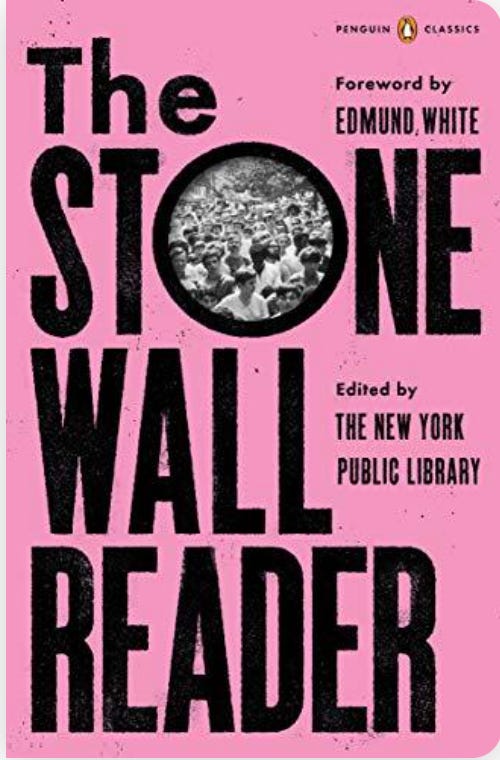
The Stonewall Reader by The New York Public Library
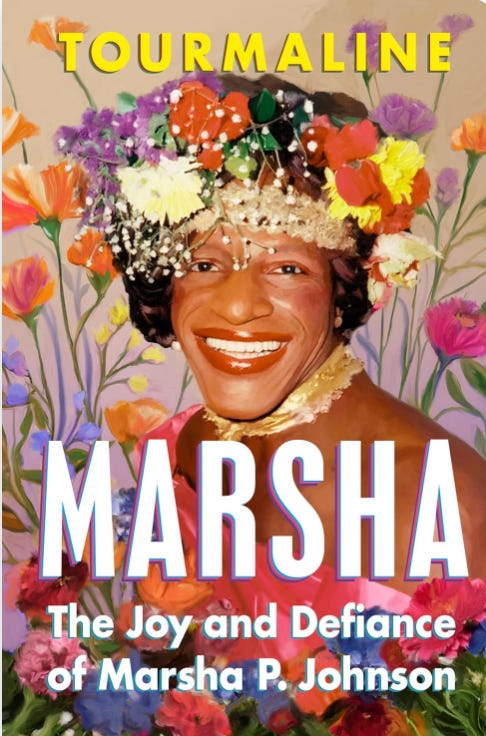
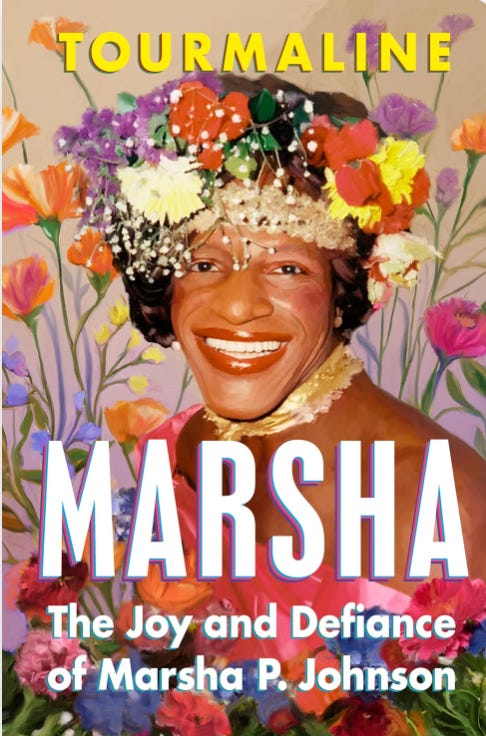
Marsha: The Joy and Defiance of Marsha P Johnson by Tourmaline
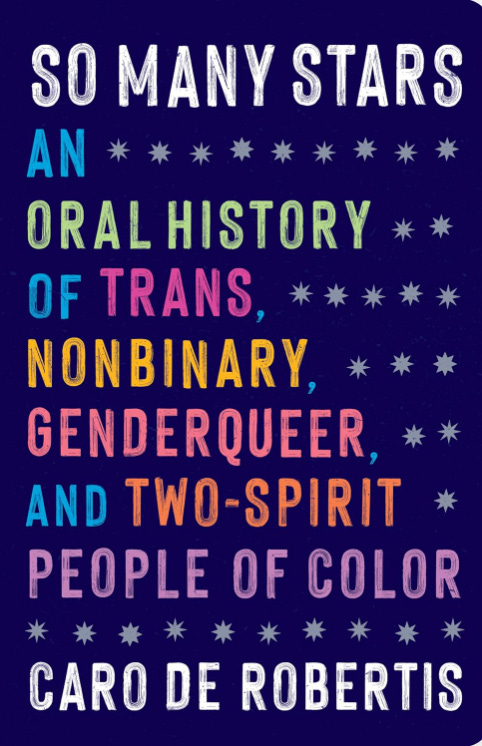
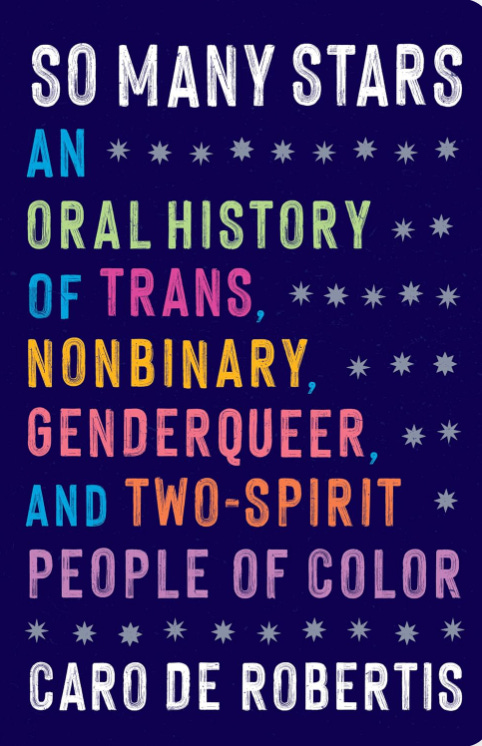
So Many Stars: An Oral History of Trans, Nonbinary, Genderqueer, and Two-Spirit People of Color by Caro De Robertis
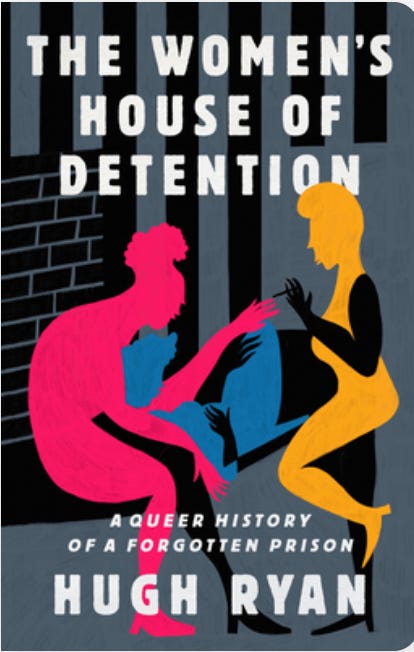
The Women’s House of Detention: A Queer History of a Forgotten Prison by Hugh Ryan
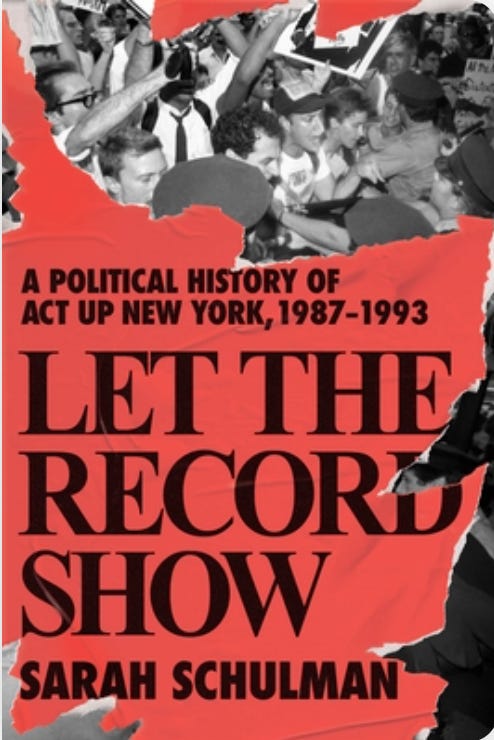
Let the Record Show: A Political History of ACT UP New York 1986-1993 by Sarah Shulman
A Short History of Trans Misogyny by Jules Gill-Peterson
Glitter and Concrete: A Cultural History of Drag in New York City by Elyssa Maxx Goodman
Real Queer America: LGBT Stories from Red States by Samatha Allen
The Lavendar Scare: The Cold war Persecution of Gays and Lesbians in the Federal Government by David K Johnson
Before We Were Trans: A New History of Gender by Kit Heyam
The Transgender Issue: An Argument for Justice by Shon Faye
Who’s Afraid of Gender by Judith Butler