

Certain Uncertainty 006: Nothing is Linear
The little room in my mind, the yearning-dread nexus, the "business" of business, books, cats and more...

This letter will take about ~10-20 minutes to read or listen (depending on the speed you select/your reading pace).
I try to record each piece I write myself, so feel free to listen to the voiceover if that’s more accessible for you or hop around to the sections that interest you 💌
Hello and welcome to Certain Uncertainty, a monthly letter from me (Kat). Here, I talk about works in progress, fixations, and the little things I’m thinking about, scared of, and feeling.
CW: descriptions of transphobia, ableism, and intrusive thoughts
In my last letter, I wrote about unraveling the knot of presence in my mind so that it’s a little more evenly distributed across my body and surroundings. So that existing in this human skin-suit doesn’t always feel like I’m just a brain knocking around in a bumbling mess of aching joints and limbs. I’m grateful for the moments where I cautiously walk across May’s verdant grass and I feel the string between my toes as, where my way of being in the world doesn’t end at the edge of my thoughts, but is connected to my surroundings by this string.
But I fear I was too simple in my explanation.
The string doesn’t unravel into a line, but rather into a collection of smaller knots and tangles, constantly expanding and contracting, tightening and loosening.
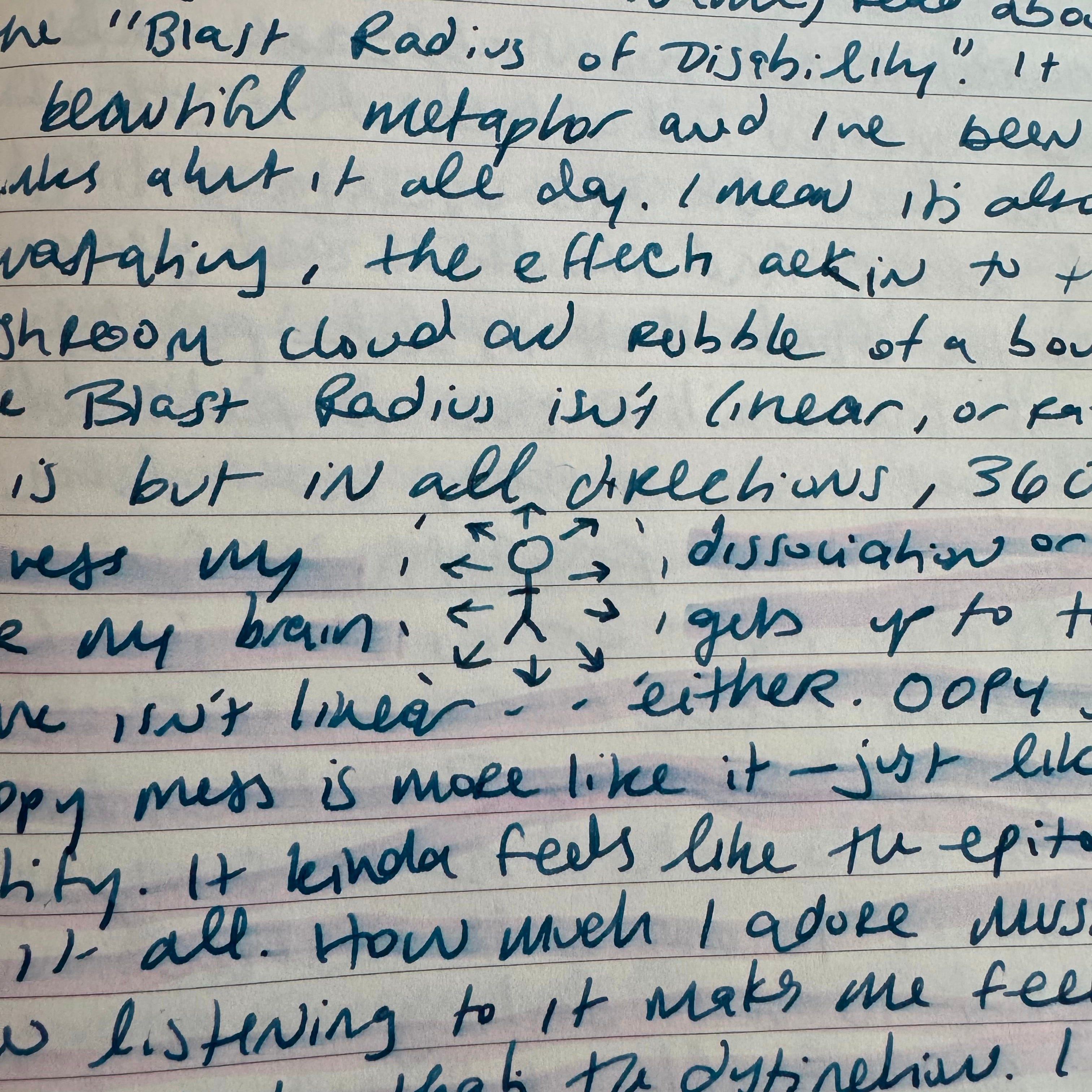
I recently read Johanna Hedva’s How to Tell When We Will Die: On Pain, Disability, and Doom. I couldn’t stop thinking about what Hedva refers to as “the blast radius of disability,” a metaphor both beautiful because it viscerally makes sense to some of us who live in the wake of that explosion, and devastating because it conjures images of rubble, clouds of smoke, and inevitable suffering. Hedva describes this blast radius by asking the reader to:
“think of bullet time in The Matrix, a 360-degree encircling sweep. In the blast radius of disability, a body like Neo’s twists and flails in slow motion, time bent to a crawl while it is also expanded into a cosmos… that swirl of slowness that becomes its own universe, the everything-ness of ourselves pierced by the everything-ness of our environment.”
What I’m learning is that my dissociation, my string of presence, my intrusive thoughts, and whatever else my brain gets up to in order to survive isn’t linear either — it’s its own blast radius, perhaps intersecting with my own disability blast radius, possibly encompassing it, or maybe, there simply isn’t a way to tell them apart.
Either way I sit in the rubble and weave these threads of questions and fears into stories, I share them with you wonderful strangers in the internet, and there is this part of me that wants to then wipe my hands clean of the blood and dirt on the rough denim of my jeans, let it all go, proclaim myself “over” that story, that particular blast radius, and wander off to find a new one to write about. Frankly, it’s astonishing that this part of me still exists, after all the intimacy with uncertainty, the non-linearity, the spiral of crip time that comes with existing in a chronically ill and mad bodymind. But alas, when I’m living at home with a family who still thinks of disability like some sort of dirty word, the internalized ableism continues to ooze through what I thought were the well-constructed walls of my mind.
I’ve been here for more than a year. May 2nd, a year since my top surgery, marked the reason I returned. Reading through the old pages of my journals and writing about that time forced me to reckon with how much my brain glossed over what it actually took to get to that point. I painted a thick shellac over the arguments with my family, the suggestion that I would be causing my body “irreversible harm” while my “brain isn’t yet formed”, that I wasn’t thinking about “how this affects the family”, or how living in California “brainwashed” me into thinking this “radical” act was acceptable; a dense wax over the exhaustion of fighting with them, not only for myself and my very existence, but also fighting with myself because of them — my intrusive thoughts latched onto their fucked up Fox News propaganda and opinions so that they arose over and over again in my mind. It was probably the least affirming situation to be receiving gender affirming care.
And somehow, for better or for worse (likely worse), I’m still living at home with these people who’ve actively caused me harm, taught me to hide, and to take up as little space as possible. Miraculously, I’ve also found a way to survive here, to simultaneously freeze the grief and thaw the love.
But that’s where the blast radius comes in: I’ve survived by creating this little world in my head, in the four walls of my room, and at my desk with my knuckles around a pen or fingertips on a keyboard. I can go to this world and be who I know myself to be, this kid who I know so well, who wouldn’t compromise themselves or their creativity for anything.
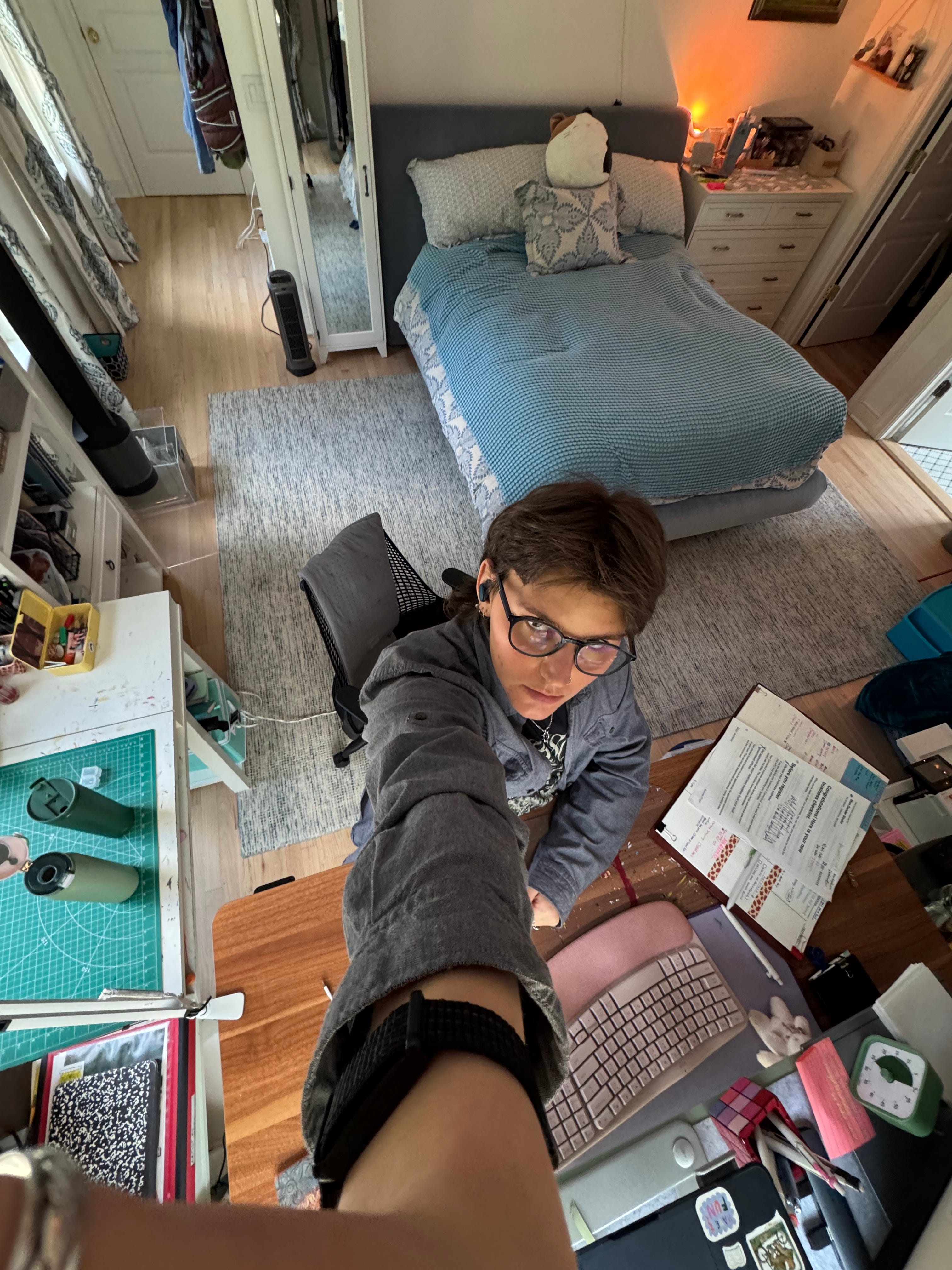
That is until I walk out my bedroom door. And suddenly, I don’t recognize who others see. This person looks like me, they talk like me, but they are not me.
A shell of me, maybe, this body that moves through the house, feeding itself and doing laundry and the necessary bodily things, this body whose truths are invisible, this body gendered as woman. Usually, when I’m not in the little world of my mind/room, I contract that knot of string so that again, I’m just a brain floating around in this sack of flesh and bone. But reading those journal entries leading up to May 2nd, 2025, every barbed word of an argument and sharp jab in a conversation made this disembodied existence hurt in a way it hasn’t in a while.
I’m grateful I’ve been able to build my little world, a safe space to retreat to, to create from; because before, I had never been home long enough to construct that space or those walls, to negotiate its bounds and values. I was perpetually in fight or flight, stuck in that tiny box labeled “daughter”. There is nothing wrong with my little brain-room-world. In fact, I love it!
But I want it to transcend the boundary of my bedroom door. I want to be seen. I want to connect with people who see me. I want to see them, too. I want to have long, spiraling conversations. I want to love and be loved. I want to have really good queer sex. I want to create, ferociously, and as much as I can. I want to feel safe enough to go from tears to laughter in the same breath.
I want.
I want.
I want so bad that I’m physically overwhelmed by how much I want.
But within this room-sized world, wanting is dangerous. Because when I open myself up to even an inkling of that yearning, a whole universe of wants comes rushing in.
But there is something else there too, familiarly dull against the shine of longing: grief. Grief for the fact that I can’t engage with these wants in a place where I don’t exist, where outside of this room, I am only a shell. So then the grief transforms too, into the other feelings that I am unfortunately intimate with at this point: the bone-deep fear, the panic, the dread, the steadfast cacophony of what-ifs.
So logically, I shut it all out. The little-room-world becomes my bubble of protection. Any puncture could bring the glow of joy and want, yes, but also the ache of dread and fear. I imagine that they’ll come pouring in through the hole, filling the space like a vacuum, collapsing the bubble of my little mind-room-world and taking me with them into a soup of feelings and fears and desires.
So I stay where it’s painful, a little muted, but safe. I stay where I am invisible, but I know there is food in the fridge and when I inevitably get sick, there will be some sort of support available.
Since I’ve moved home, I’ve imagined moving out, or at the very least, tried to imagine. For a lot of that year, I was experiencing debilitating intrusive thoughts that made it difficult to leave the house, and once again, not linear, they still sometimes arise. Like the yearning-dread nexus, like my proclivity for dissociation, moving out is everything I most want and fear simultaneously wrapped together. I could spin hundreds of stories out of things that terrify me about moving out, that transition, and the process of moving in general — fears that make me feel like I’m moving through glue, a sticky stuckness that’s impossible to untangle.
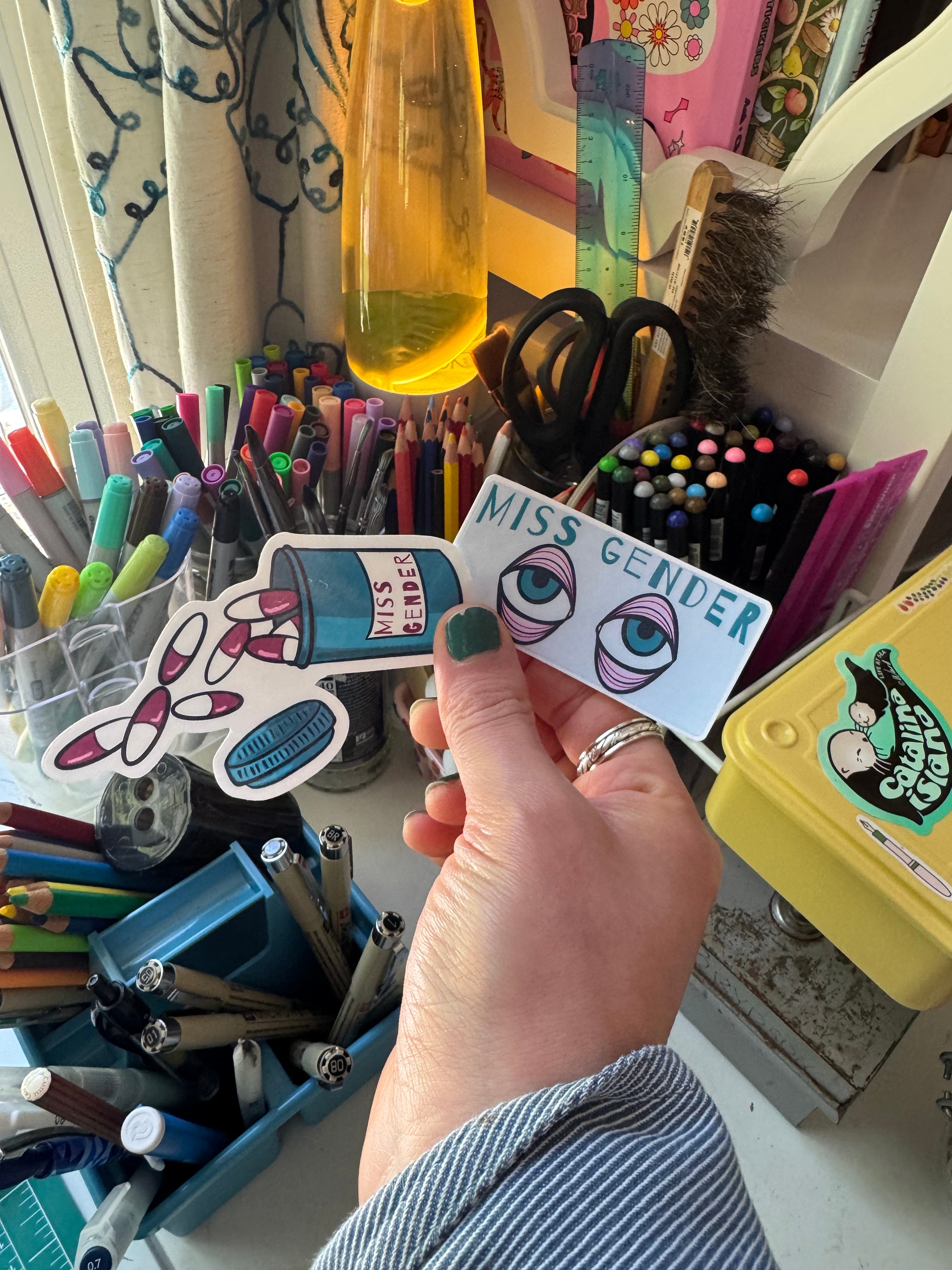
But for now, I’m spending most of my thoughts/time/space/energy/spoons on starting the creative business of Miss Gender, a small print and sticker shop. I hate how this sounds when I write it or speak it out loud. This business of “business” comes with a lot of capitalist baggage and it can leave a bitter taste on my tongue because I don’t want people to misunderstand.
So let me explain: I’m not starting a business because I want to or it’s my dream, I’m starting a business because I want to survive.
I’ve been working in the same remote nonprofit job for almost a year now, and I know that if I continue with this job or any other normative, remote job that my body could semi-handle, I will, without a doubt, burn out. I already feel myself singeing as I sit in meetings and hear abbreviations like “KPI” and “3YP” and every time another deadline is added atop the pile of deadlines — a world too many deadlines for the minimum wage I’m paid. I describe it to my friends as feeling like my soul being scooped out of my body with an ice cream scooper, scraping the marrow of my creativity and pleasure bit by bit. I don’t want to let them empty me.
The “business” of art is my alternative. It’s risky to monetize your creativity, but there isn’t really another option for me. Or rather, there is another option, but I’ve seen it and I know I won’t survive it. So it’s not just a small art business, it feels like the existential core of my existence. And that’s a lot of pressure to put on something that likely won’t work out or actually sustain me for a long time. Plus, I hear my dad’s disembodied voice in my head saying that I won’t be able to pay my bills, that I’m lucky to be able to work remotely, that I’m ungrateful, unrealistic, that I don’t know enough.
And that makes me want to bang my head against the walls of this room-world, and in true non-linear fashion, I’ve spiraled back to moving again — a terrifying endeavor I feel like I can’t physically/mentally handle while I’m working this normative job, yet it feels too risky to move without it.
It’s a circle that curves and spirals and tangles and twists. It’s the blast radius and it’s how I make sense of the rubble. It’s wanting to use and exist within the body attached to this brain, it’s wanting to feel the yearning without being flattened by the dread, it’s holding both the grief of my family and the immensely stubborn love, it’s a business without emphasis on the business, it’s that string that continues to tangle and unravel and tangle again, and it’s trying to hold all of these things at once, to spin them into stories but allow those stories to change too, it’s allowing myself to be utterly and enormously confused.
It’s me saying that I’ll let you know if I ever figure it out, and us both knowing that I probably (definitely) won’t.
In The Stack
A section where I talk about my current hyperfixations, special interests, and the recommendations I’m keeping in my literal/proverbial bedside stack.
How to Tell When We Will Die: On Pain, Disability, and Doom by Johanna Hedva
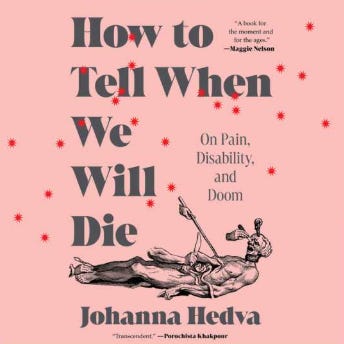
I’ve read a lot of nonfiction over the past year, and nothing affected me quite like this. Hedva’s voice gripped me through my earbuds and their words followed me around my days, haunting me in the most beautiful ways. I could write a whole other essay on things I enjoyed about this book and Hedva’s writing, but for now I’ll stick to my favorite: the way they write about being an artist. The fact that their work matters and is worthy of not only making but sharing and dedicating limited time and spoons to is akin to the fact that the sky looks blue.
Fat Swim by Emma Copley Eisenberg
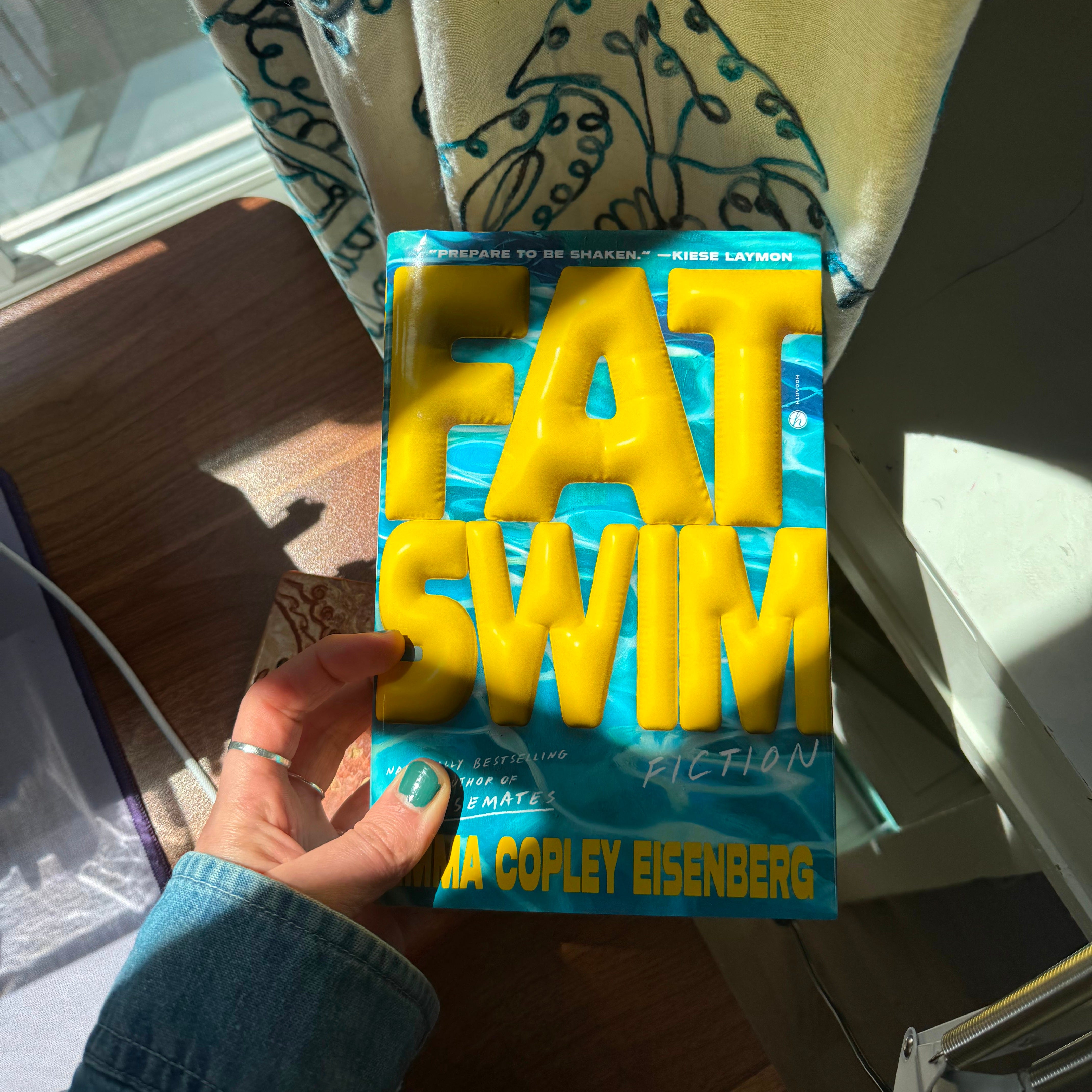
I loved Eisenberg’s Housemates, so when I came across an opportunity to preorder their book and take a virtual workshop with her, I immediately signed up. The workshop was titled “Your Natural Grammar” and centered around pinpointing the unique way each of us has come to write, speak, describe, and tell stories. The grammar of parents and hometowns and favorite authors and tv shows that snaked their way into your vernacular before you knew what was going on. I remember asking a question about how grad school helped her “natural grammar” versus hindered it. She offered an incredibly thoughtful explanation that included how folks in her MFA would point out her way of describing people’s bodies using visceral, distinct language. She explained how it wasn’t very helpful that they wanted her writing to be something else, but it also helped her understand what she was drawn to writing in the first place. I approached the book with that context, and every other page I was frantically highlighting a passage that I loved, that felt distinctly Eisenberg-ian. My favorite is about eating a chipwich:
“By late afternoon, Rob would wobble to the beach snack bar, returning with a sheaf of fries for him and Chipwich for me. Though covered in a fine layer of ice crystals, the Chipwich was soon soft. I ate the edges first, the mini chocolate chips crunching between my back molars.”
I love it because sometimes it is the profound descriptions or statements that grab us, the render the tip of the highlighter on the page, but sometimes it is the mundane, it is the sweet and temporary, the Chipwich.
Befriending your neighborhood cats
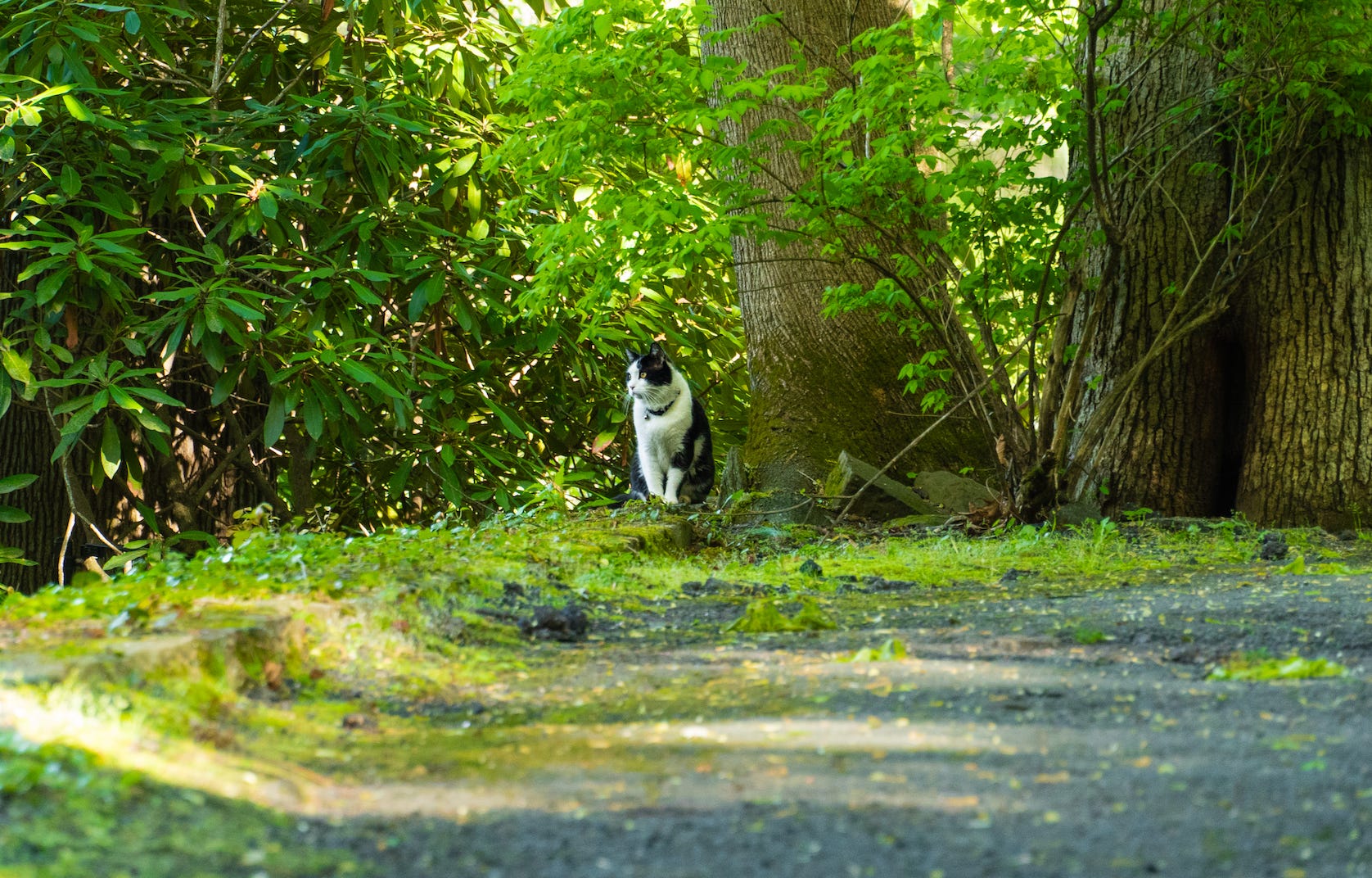
There are a few cats in my neighborhood. A black and white elusive one, a chunky orange one often found lounging in the sun of his driveway, and the little inky black Big Mama who lives a couple houses down. I think Big Mama’s actual name is Bear, to me she is Big Mama because of her adorable swinging pouch. Like me, the cats hibernated all winter, but recently I’ve started seeing them out and about more.
The other day I was wandering around my street looking for things to take photos of when I came across the elusive black and white cat. Despite my coaxing and desperate pss pss psses, she ran off after being barked at by a resident dog. I texted my friend immediately: “all I want is for the neighborhood cat to let me pet them”
Lo and behold, on the way back to my house, Big Mama crossed the street. The woman walking her dog in front of me must have been superstitious about black cats crossing her path and immediately turned around. I, on the other hand, made a bee-line towards my friend. We spent 10 minutes rolling around in the grass on the side of the road. There is nothing like a cat first head-butting your hand and then descending into rolling around in purring excitement.
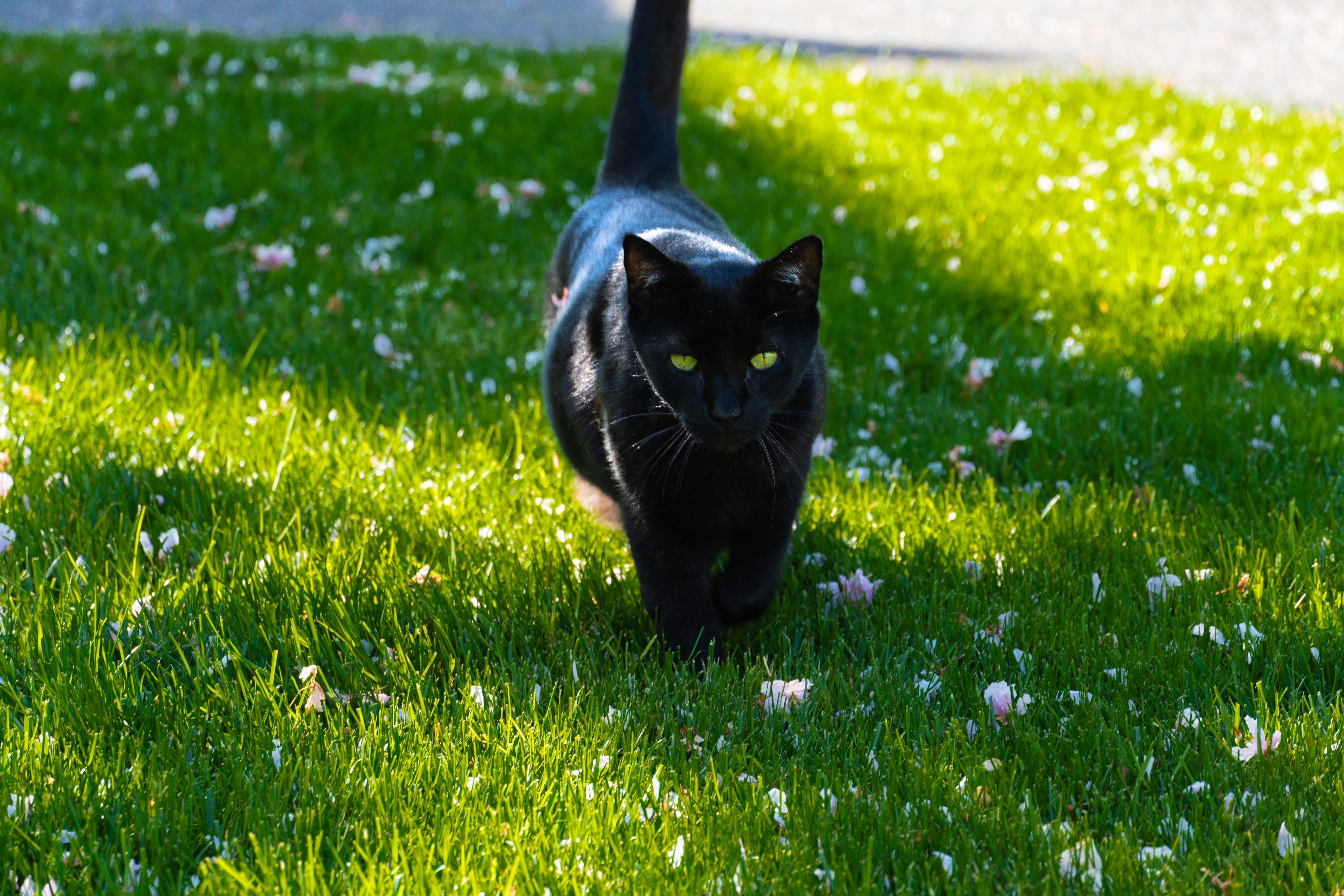
A few days later, Big Mama found her way to my house, scaring me as I was bringing some packages inside at dusk. She didn’t want to leave and we had another late-night purr-fest. I swear we knew each other in a past life. Moral of the story: find out if you have any neighborhood cats and befriend them immediately.